Monday, July 27, 2009

F&M Celebrates What Exactly?

i spotted these signs on my daily walks with sonny and Eve. at first i didn't think much about it... it's a sign but see'n it everyday made me think.

1. 40 years isn't that long. my mother-in-law graduated from little Hiram College before 1969.

2. F&M has been around since the late-1700s.

3. This doesn't seem like that good of a thing to celebrate.

4. what exactly is the "Legacy of Women" that this sign is trying to convey? That it's great F&M is co-ed or that women had to endure 182 years of being ignored before they were accepted?

so this made me want to know more about this college that's right across the street. here's what i found on wiki:

Since its inception, Franklin and Marshall was an all-male institution, although Franklin College had enrolled female students and women were permitted to attend summer school classes at F&M beginning in 1942. Continuing a trend in single-sex schools across the country, the Board of Trustees announced on January 17, 1969 that it had voted to admit women to F&M, a decision that was unanimously and enthusiastically supported by male students. In the fall of 1969, 82 freshman women and 34 female transfer students were enrolled in F&M's first coeducational class.


it is my humble opinion that maybe the signs are ill-worded. this doesn't seem like a legacy that i'd want to celebrate. maybe it's me expecting a little more from the 17th-oldest college in the United States, but this celebration of being one of the "lasts on the co-ed boat" doesn't sit well with me. your thoughts?

Thursday, July 23, 2009

Absolute Truth?

much of this comes from Socrates Cafe by Christopher Phillips

To understand absolute truth, one must start with what exactly is the world and our location in it. Thomas Hobbes inthe Leviathan states that the "world is the whole mass of all things that are" but is never very clear on what he means by "all things."

Immanuel Kant talks about 'two worlds' which are very Platonic in formation. He talks about thephenomenal world and the noumenal world. Phenom: knowable by senses and interpreted by the mind. Noum: that which lies beyond the world of space and time, cause and effect. Kant talks about this is where Absolute Truth exists.

Plato talked about the world we see, like shadows and reflections on the wall of a cave. the absolute truth is beyond the walls of the cave and very few ever make it out, and those who do, it hurts their eyes and no one believes them.

John Locke talks about how truth can best be known through science and religion, namely that Christianity is the most reasonable and natural choice (duh, cause you're a Christian Locke...). nature holds the absolute truth but reason is the only means in which to interpret it and gain it.

Ludwig Wittgenstein stated that the world is "the totality of facts" which contain a logical structure that shape and delimit our world. facts are inherently knowable but "we must be silent" about the so-called unknowable until it is revealed.

Aristotle stated that the world we speak of, the universe as a whole is always being talked about through our relation with it. there is no such thing as objectivity or a "view from no where" but all views are a "view from somewhere."

in his novel The Manticore, Robertson Davies talks about the "view from elsewhere" which states that the best we can do is seek to embrace views besides our own. this is echoed my Parker Palmer in the statement "The truth is between us." meaning that truth is relational and exists solely through interaction and relationships with others and the wider world (nature, animals, etc).

so which is it? where do you fall? i see the merit in many of these views but fall more with Aristotle, Davies, and Palmer than the others. any views you can think to add?

Tuesday, July 21, 2009

Summer Reading Thus Far

it's been a great summer of reading so far, here's what i've been up to:

Twilight by Stephanie Meyer: The vampire/teenie sensation. i'm not above reading these pop novels and i really enjoyed it. i wondered why i was able to read it in 3 days and that's because i didn't have to think about what i was reading the whole time ;-)! which was a nice change. i think it's an excellent methaphor for teenage sexual tension and abstience. you can definately feel the Mormon influence in subtle ways, but i enjoyed the recasting of what vampires are and esp. the concept of "good" vampires.

Socrates Cafe by Christopher Phillips: dude quits job so he can hang out at coffee shops and ask questions. sounds like my dream job! i'll post more on this book later because there's some questions i want to cover here... this book is a great read for the beginnning or expert philosopher even though, at times, it is poorly worded... like i should talk, i'm the poster-child for that ;-)

A New Kind of Christian by Brian McLaren: Is really a wonderful book. it mirrors closely to what i believe.. it's about an evangelical pastor who is thinking of quiting the ministry meeting with his daughter's high school science teacher who used to be a pastor as well. the pastor is introduced to post-modern thought by the science teacher and the conversations are full of wonderful stuff. this book is giving me a new perspective, not only on what i believe, but also on what others believe. my evangelical and more conservative/traditional brothers and sisters concerns are presented in a way i can understand. like why have the bible be inerrant and infallable? this book helps me understand that and how best to talk about theology without getting defensive.

When Bad Things Happen to Good People by Harold Kushner: in preparation for my CPE program this fall (CPE= hopital program to see where your buttons are and to come face to face with tragedy) i figured i best read this classic on why we suffer. i really enjoyed this book and learned a great new insight on the Genesis story of creation:

from pages 72-73: God is represented as saying, "Let us make Man in our image." Why the plural? Who is this "use," the "our" of which God speaks? My suggestion for understanding this sentence is to see it as connected to the sentence immediately before it, in which God creates animals... Let us fashion a creature who will be like you in some ways--needing to eat, sleep, mate-- and will be like me in other ways, rising above the animal level. You animals will contribute his physical dimension and i will breathe a soul into him.


i love this understanding because it's more biblical and literal. no apologetic nonsense of God talking to the heavenly hosts. this is closer to a biological understanding of creation, right inline with what we're finding out through Evolution. i LOVE it.

Reel Spirituality, Theology and Film in Dialogue by Robert Johnston: for my Theology and Film class which i'll post on later as well. talks about how movies are now the new means of conveying and portraying our sacred stories. i agree with this.. we've gone from sitting around the flickering fire to sitting looking at the flickering screen. there's even a whole ritual that goes along with going to the movies.. popcorn and soda is the new communion, the previews are like the call to worship, and then the main event. could movies be the new church?

i'm looking at two movies, Defiance (starring Daniel Craig) and Fight Club (starring Edward Norton and Brad Pitt) for my final paper. i hope to post the movies we covered in class as well, Gran Torino, Atonement, Maria Full of Grace, Doubt and Cold Mountain. look forward to those!

coming up on my reading list: Selections from Kirkegaard, The Dangerous Act of Worship, and Domination and the Arts of Resistance. stay tuned and hope your summer is going well!

Thursday, July 09, 2009

Systems Fail

what if I say you're not like the others
what if I you're not just another one
look at your face, you're the pretender
what if I say I'll never surrender x2

in time I'm so I'm told
I'm just another soul for sale, oh well
the pages I repress
they are not permanent, they are temporary, same ol story


...and i'm not the only one.

Tuesday, July 07, 2009

Summer Update

Hey there fellow bloggers! I know you're waiting for the next installment of Reformation:the sitcom but i'm having some trouble with the 3rd ep. and also wanted to clue you in on what i've been up to this summer.

i just finished up the Leadership NOW academy where i worked as an adult mentor. Leadership NOW creates safe space for young people to explore question of meaning and vocation. Space for struggling, thinking, exploring, learning and seeking deep faith.it is an awesome experience! check out their new website it never fails to inspire me and keep me working to become a pastor.

this week i'm taking a class at the summer academy called "Theology and Film." we cover various theological points raised by some movies.. yesterday we watched Gran Torino and talked about how it's a classically christian movie. i'll post more on this on thursday.

Eve had a great time with her grandparents as they were here to help us out when i was at the academy. i didn't get to spend too much time with them, which stinks, but Eve did and that was awesome! Eve is doing great and growing like a weed! she's so freak'n cool!

Thursday, July 02, 2009

Commentary on Episode Two

this is the shortened version... Erasmus and Luther duked it out over this concept rather heatedly and for all intensive purposes, Luther won out. I side with Erasmus.. but i see the merit in Luther's position, trying to establish God's sovereignity. just as Dawn says at the end, "We're predestined to have free will" love that line and the reactions of the other two seminarians.

the buzzing in Episode One was from the remodeling projects going around at F&M the college across the street. you can still hear it here too. out of our 5 hours of shooting the work lated 3.5 hours of that. so that kinda stunk.

i'm really happy with these small snap shots. originally (in the script) these would have gone on while the credits rolled, after you got the full helping and theological support from each of the reformers (and then you'd know why Erasmus lost) but due to the constraints of shooting, this was the best option. notice how Calvin talks the longest, something he'll be doing from here on out. he has a lot to say and write on all these subjects as he constantly is working on these issues. he's best known for predestination, but he has a pastoral methodology to his work. never does he damn others to hell but simply hopes that they will one day join the church. it is his later followers which do that dirty work, which inturn tarnishes Calvin. but Calvin did set himself up for it.

we humans can use anything as weapons... physically or spiritually.

Wednesday, June 24, 2009

Episode One: The Magic Eightball Commentary

first episode was really fun to shoot. it was the one where i took the most liberties with the characters... from here on out, largely the Reformers will be speaking words that they wrote themselves in their various debates they had between them.

Some explanation of the episode:

the reformers match up like this: Erasmus modern counterpart is the Anglican, Luther is the Lutheran, and Calvin and Zwingli are UCC.

Zwingli is an iconoclast and that's why he likes the library (unadorned Bauhaus/International style) and takes down the picture of Christ that Erasmus hangs up.

Luther posted the 95 which was very famous. Zwingli had his own list which was 63 aspects of what he thought was the Christian religion. Calvin read all of these, including other works by Erasmus and the Brethren reformers, and encorporated and debated all of their concepts in his Institutes which is a massive work that he constantly worked on. So after Calvin gets the superior parchment and pen (he stole from the Lutheran) he will constantly be working and writing and only looking up to synthesize debates other reformers are having.

I really enjoyed what the actors brought to the script, i wish i had more film training to capture their energy and work, but think this final cut has more pluses and is pretty close to what i had in my mind. Luther's famous "By Satan's Smokey Ass" phrase (that i got the most comments about) was adlibbed by the actor Jim Siburt, who also suggested the ending song by the Super Furry Animals which i love!

Episode Two is coming up next! Stay tuned!

Sunday, June 21, 2009

REFORM!!

Reformation: the sitcom, episode 1, The Magic Eightball parts 1 & 2. Commentary on Thursday! enjoy!

Part One:


Part Two:

Thursday, June 18, 2009

An Entertaining Theology

I absolutely LOVE Barry Taylor's "Entertainment Theology: New-Edge Spirituality in a Digital Democracy." I love it so much that I'm thinking of just submitting this book when it comes to putting in my ordination papers... but i don't think that will fly with my future committee.

here are some great quotes that Barry uses to introduce his chapters that I will use to speak about this wonderful book:

"...At the very cry from the cross: the cry which confesses that God was forsaken by God. And now let the revolutionists choose a creed from all the creeds and a god from all the gods... they will not find another god who has himself been in revolt... They will find only one religion which God seemed for an instant to be an atheist." -G.K. Chesterson: Orthodoxy


Taylor talks about a re-encoding of the message. Taking artistic license, risking and endeavoring to take new routes with stories that have so long been closed to new meanings. No longer can the theological connection point for Christianity be "You are a sinner who will die in your sins unless you repent. You must be born again." Taylor asks "Is it really the only connection with God through the Jesus story? I think not, though I think it is A connection to Christianity and has been the dominant mode of connection in the church post-Reformation." (page 198).

This approach means no pre-packaged dogmas, doctrines, or resting on old answers. Nor is it throwing out all the dogmas, doctrines or old answers. It is a wide net that Taylor is casting... or actually, asking others to cast. It is a multi-disciplinary approach to life that seeks to encapsulate and make room for people "at the foot of the cross... even atheists." It is keeping Christus Victor right alongside all the other forms of atonement and inventing new ones or not having atonement at all! All of these are possibilities depending on context.

"Poetry will reach a superior dignity, it will become in the end what it was in the beginning---- the teacher of humanity." Friedrich Schelling, Philosophy of Mythology


Taylor constantly uses pop culture to talk about his spiritual outlook. He is quite wise to point out the difference between the movies Stigmata and the Exorcist. He then uses movies and art and poetry to classify 4 movements and expressions of spirituality in the world: 1. Zen Culture 2. The Next Enlightenment 3. Retrolution and 4. Resistant Communities. here are some brief descriptions:

Zen Culture: a "westernized Asian Thought" is being seen through the growing popularity of Anime, ancient wisdom, and use of imagery in movies. Think THE MATRIX here, where it is a blend of Christianity, Gnostic, and Mystic western thought mixed with Tao, Buddhist, Zen, and Kung-Fu eastern notions. Much like the music that's produced by Washington D.C.'s own Thievery Corporation:


Next Enlightenment: Rational Mystics Taylor terms them. Books like The Celestine Prophecy and the Golden Compass are about finding ways to connect to the divine and trusting one's self to do that without the traditional support structures of formalized religion. This approach is all about the WHOLE PROCESS of things and emphasizes community, relationality, and level playing field... there is a "serious concern for their inner lives with a strong penchant for social activism, including a commitment to a sustainable future." but Taylor notes that it's equally important to see their dislikes and those are "social inequality, intolerance, and the Religious Right." U2 would be the biggest band in the strain, but then you get Springsteen, Saves the Day, and the Flobots here as well. Here's one of my fave songs by Switchfoot:


Retrolution: Postmodern Gothic, a blend of ancient and modern.. like what we find in The Da Vinci Code, Harry Potter, and Donnie Darko. These stories "explore the old and a little under the surface deal with the new; past literary forms and present concerns exist side by side." The is also an element of mystery and shock value and no guarantee for happy endings. Think spirituality ala Marilyn Manson, Slipknot, and Nick Cave and the Bad Seeds. can't count the amount of social and religious imagery found in my fave Manson video (not to mention the cheerleader like chant within it, i LOVE this song!):


Resistant Communities: the religious right, street preachers, and the like. Jerry Falwell style, that is directly engaged and obsessed with "the other". This community has a desire which is commoditized and the motivating factor is fear. The Left Behind Series would be an example here. Of course my bias is showing here... not Taylors.. because i'm rather sick of these communities and i deal with them all the time. they want to rest of "old answers" yet ignore that the answers they're coming up with are new permutations of old things... there is many positive aspects to these communities, it's not all bad.. and there's even some good music coming out of it... well it's been awhile, but here's what I remember being "cool" when i listened to "Christian Music":


I highly recommend this book! I'm all about it! I feel that it perfectly articulates many of the crazy thoughts zooming around in my head. I hope you'll check it out!

Tuesday, June 16, 2009

A Sermon and a Project

I worked for the last year as an intern at Trinity Reformed United Church of Christ in Mountville PA. The pastor there, Pastor Nancy, is awesome and we had a great time. I have a life-long mentor and friend here. She has started her own blog, quite awhile ago, and i neglected to promote it. Well, here's a great sermon by her talking about faith.
My fave. quote is "Faith is a person’s or group’s way of moving into the force field of life. It is our way of finding coherence in and giving meaning to the multiple forces and relations that make up our lives."

Julia O'Brien is the prof of Old Testament here at LTS. She has started a new program on her blog called "Reading the Bible as an Adult." The jist of it is "This project helps readers from differing backgrounds engage the Bible as grown-ups: showing them how to read carefully, pointing out the human dynamics of the text, and providing questions that invite discussion about the dynamics of the stories and the realities of people's lives." Check it out here, i think it's extremely facinating.

Sunday, June 14, 2009

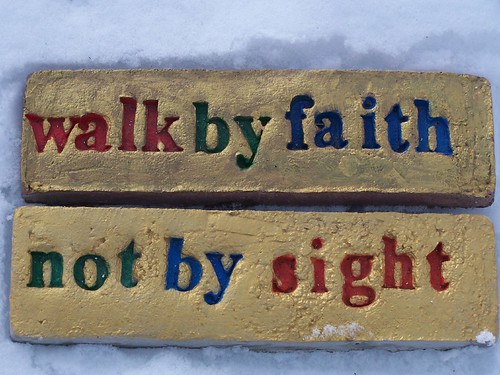
Walk by Faith

American Idol judge Simon Cowell is also the creator of a show called Britain’s Got Talent. He wasn’t having a good day at auditions this past April. “God this is horrible.” He said before the show went to break. When it came back from commercial, Simon was greeted by a middle-aged lady who looked… well, like nothing special. Susan Boyle looked homely and she’s from nowhere special. Simon immediately dismissed her, but since he had to talk to her, he punctuated all his questions with eye rolls, shrugs, and a body-language that said “Oh please.”

How many of you have heard Susan Boyle sing? Was it what you were expecting? [Watch the video here]

Susan sang. The crowd went NUTS for her singing and the judges just stared at the song bird that landed on the stage. Simon… well not just Simon, everyone was expecting failure. It’s the oldest sin in the show-biz book, judging a book by its cover.

In today’s scripture we hear one of Paul’s greatest pieces of wisdom, “We live by faith, not by sight.” Susan Boyle is the embodiment of this phrase. She showed a sexist, ageist, fashion-concerned world what it means to live by faith. In her short 90 second performance, she offered a one woman antidote to all the cynicism that had engulfed the world during this recession. She wasn’t a greedy banker, or corrupt politician. She wasn’t in this for fame or fortune. She had no interest in being another celebrity or raking in piles of cash. She had spent her entire life dreaming of being a professional singer and she had faith that she could do it despite being the full-time care-taker of her mother, despite not looking the way the world expects, despite never going 60 miles from her hometown; Susan had a gift and she had confidence in this gift. She knew it would take her places beyond her wildest dreams. She walks by faith.


We’re steeped in a world that loves what it sees. We are in a world that lives almost exclusively by sight. My college degree was in advertising, so I was set to make my career selling things to you all by sight alone. Doctors Michael Brower and Warren Leon state that “The average American is exposed to about 3000 advertising messages a day, and globally corporations spend over $620 billion each year to make their products seem desirable and to get us to buy them.”

Living by sight means that you have to have the new product, wear the deodorant that gets you the girls, but make sure that you’re wearing the right clothes, driving the right car, and completely defining yourself by appearance. If the world was like advertising would have you believe, then one paper towel can hold a bowling ball. The Eiffel Tower can be seen from any window in Paris. Household cleaning products hold the key to personal fulfillment. Medieval peasants would have perfectly straight teeth. And if you buy this SUV, you can take it off-road, it will never get dirty, and you’ll never drive in traffic, ever.

Living by sight is SO limited because we so often get it wrong. We misunderstand or misinterpret things which are right in front of us and get too concerned with just staying on the surface of what we know. Here are some examples:

In the year 100, Roman engineer Julius Sextus stated “Inventions have long since reached their limit and I see no hope for future developments.”

In 1893 a journalist wrote “Law will be simplified over the next century. Lawyers will have diminished and their fees will have vastly been curtailed.

In 1895, a teacher wrote to a father of one of his students that this student… this Albert Einstein “will never amount to anything.”

In 1949, a computer scientist stated that “It appears we have reached the limits of what is possible to achieve with computer technology.

The head of the patent office in the 1960s wanted to close up shop because everything had already been invented.

I could go on and on. The world is chock full of examples of living by sight.
So how does this concern you? When you pick up your paper or watch the news, it’s easy to fall into despair. Shootings at the holocaust museum, global warming, war, famine, bail outs, company layoffs, the list goes on and on. Paul is seeking to remind us of where we get our purpose and direction from. Sight, Paul argues, is the surface layer; faith is the insight that gets below the surface to goodness, truth, and love.

However, living by faith and sight can be done at the same time. Sight and insight operate together as they do in looking at a painting, where we see not only the forms and colors of the scene but also its beauty. To see beauty, it takes insight. It’s easy to see the beauty in the Hollywood actor or actress, much harder to see it in Susan Boyle or our neighbors. That takes insight. Beauty is something which cannot be measured or completely understood, but we know it when we see it through our insight, through our 6th sense which is our faith.

Walking by faith does not mean that we walk entirely in the dark by a kind of blind trust. It doesn’t mean taking what the bible says, what authorities say, what institutions say literally and unchallenged. A struggle takes place. An interested investigation launched. Remember Doubting Thomas?

There will be times when we have to walk by the light of our faith with only the memory of the insights that were once clear to us. Walking by faith doesn’t mean that once you have an insight, that’s the final and absolute truth… no. We as Christians believe in the Holy Spirit and the Spirit moves and guides and changes and challenges us and provides us with new insights… some of which contradict the old.

Walking by faith is asking questions and questioning the answers. This form of inquiry in many ways resembles the scientific method. But science fails to address such important human concerns as sorrow and joy, suffering and love.
Walking by faith doesn’t mean you’re standing still. Resting on old answers. When we walk by faith we follow the Spirit and Christ. Jesus walked the walk.
He was born out of wedlock. He hung out with the wrong crowd. He was from some backwoods town and couldn’t possibly amount to anything. He was put to death in his culture’s most shameful way and yet here we are 2,000 years later still talking about him, calling him the Son of God.

Walking by faith takes a lot of courage and effort and many just don’t want to do it. But there is power in it. It is a power that the world doesn’t really understand, not really, because there’s no guarantee. In fact, it actually looks like losing. The power of walking by faith is a paradox; it’s power that looks like weakness. More than that, it is not guaranteed to stop all evildoers. It might, of course, touch and soften their hearts. It enables you to recognize God’s power positively at work in the world.

This way of living comes at a price. It can leave us with the sense that we don’t know the answers after all, that we are much further from knowing than we’d ever realized before. This humble way of living shows us that there are many more angles by which to examine life than we ever imagined. As the ancient rabbis said, “Those who say they know are much further away from the answer than those who say that they don’t know.”

Take care to distinguish between externals and internals. Question your snap judgments and check to see if they hold water. If it looks like a duck, quacks like a duck, and swims like a duck externally, internally that duck may think it’s a flying tiger or a Tyrannosaurus Rex. That frog maybe a prince in disguise. Just like Susan Boyle who looks as plain as the day is long, but inside has the voice of an angel. Jesus, who looked like a backwoods carpenter well he’s divine. He’s the way, the truth, and the light. AMEN.

Thursday, June 11, 2009

What governs my theological thinking?

“You want to know who I really am, yeah so do I.” –“See You” by Saves the Day

I had to write a "prolegomena" for my paper for doctrine. This gives the reader some background for what is to come next. I did my paper on the doctrine of the church, which i'll post parts of here in the near future. Before that, i thought i'd share this little diddy about how and why i think:

Personal experience is the start which is tempered by logic, reason, and testing these private moments against other people’s experience. For me, that is largely what religion does for me most naturally. Scripture is a tried and true measuring stick as well as a challenger to any notions I think I’ve landed on. The irrational fullness of life taught me never to discard anything. Even when it goes against all our theories, odds are, we need to reconsider these theories anyway. I try not to hold on too tightly to any notion.

This is, of course, disquieting and I’m never certain whether the compass is pointing true or not, but security and certitude does not lead to discoveries. My life has been one of constant change and challenge and my theology and thinking reflect this. I come out of a Jesuit, natural theology with a healthy amount of Roman Catholic doctrine and dogma. This is what I’m always measuring against and reacting too. I still feel like I’m learning to be a Protestant and that I’m young enough that I still can’t say what exact ideas govern my thinking.

What it consistently boils down to is context, mystery, revelation, and praxis. Context is everything. I must be humble enough to say “I don’t know” in any given context, yet strive to find the extreme points and find the middle path (predestined or free will? Yes! Horrible sinners or rational, transcendent beings? Yes!). I must rely on God for revelation, which means I must be out experiencing the world as revelation only comes through experience. And I must put all things into practice because theory without practice is pointless and practice without theory is thoughtless. All of these are intermingled, like concentric circles or better yet, four in one. I don’t know how they’re all in there, but they are!

Tuesday, June 09, 2009

Trip to Ohio

this past weekend, Kate and I took Eve for her first trip to the land of our birth. the land of the bobcats, O-H-I-O! It was both great and bizarre to be in the place where i grew up with my kid.

Kate's sisters threw a "welcome Eve" shower/party/shin-dig and a ton of our friends and family showed up, including our DC friends who moved to Cincy, our C-bus crew, and Kate's aunt from San Fran! it was such a great time! the food was great (Sweet Baby Ray's Pulled Pork, YUM!), the weather perfect, and the conversations were great. i can't think of a better way to spend a saturday.

I was asked "So what was the greatest revelation/change since becoming a parent?" this comment really struck me and i had the following things to say:

1. I have a stake in things. I need to recycle more, keep healthy, and work to preserve the world and make it a better place for my kids to grow up.

2. I am no longer just me. and i never was "just" me. we have the idea that we can be individuals without contact with others, but i can't describe myself without talking about a relationship. I am a husband, friend, brother, son, and now FATHER. i used to fear this last title because of how my own father operated. but now i love this title! my identity is no longer just about me, it's about what type of person i am to my child as well as my friends and family. my identity is corporate, it always was, but now this concept is more of a reality.

we all are in community and relation with one another. i think that a balance needs to be struck between total individual (as this can result in an inflated ego, a sense of isolation leading to depression, or a skewed view of reality) and total community (as this can result in anxiety and a general laziness that "someone will take care of it, "I" don't have to do anything cause there is no "I").

3. Different Priorities. I love my single and no-offspring friends, but our concerns aren't the same anymore. that's okay, that diversity is what makes life interesting! but many ideas, concerns, or stances on issues, i just don't have or hold any more.

that's about it. the trip home also caused me to look through some ol' high school poetry and writings. man, what a collection of self-righteous pissings! i was angry! but that's what happens when you're out of place in a community and not using what is in front of you. i was frustrated by the smallness of my hometown, but i now see the beauty and gifts that experience has given me.

it was a busy weekend. it was a reflective weekend. it was a weekend at the first of the month and that means CANTON FIRST FRIDAY!!! My sister-in-law is in charge of this event, which is part block party part gallery hop. it is outstanding. Lancaster has a first friday as well, but it is nothing compared to the shin-dig Canton puts on. There were the Budweiser Clydesdales, musicians left and right, wonderful art and photography, a slew of diverse peoples (GREAT people-watching!), and the Society for Creative Anachronisms beating the crap out of each other with their home-made swords. it was AWESOME! oh! not to mention that every Saturday after 1st friday there is Scared Scriptless which is a "Who's Line is it Any Way?!" style impromptu comedy show. Downtown Canton is the place to be.

so there's my plug, where's my $50 Sarah? ;-)

Thursday, June 04, 2009

John Calvin

John Calvin was not a man who inspired immediate confidence in those who first met him (Steinmetz 3). He was a slight man, shy and bookish, never robust and plagued by illness (Steinmetz 3). He is a man of order and peace born into a world of conflict (Parker 9). He was conservative by nature, by upbringing, by conviction, and his theology as so old-fashioned it seemed a novelty (Parker 9). He called himself a “lover of shaded paths and retired groves” as well as “merely a man among the common people” (Parker 9, 17). He also thought of himself as a “God frustrated Scholar” meaning that his plans had been set aside to do God’s will (Gerrish 152).

He had an unbelievable list of physical ailments, an inexhaustible work ethic, and he was sharp-tongued and short-tempered (Gerrish 152). He was irritable and difficult because of these circumstances yet those who were his friends testified to the deep affection and unfailing concern he showed them and to any who turned for him for help (Gerrish 153). Calvin has been chiefly defined as a rigid and systematic bureaucrat and theologian. However, Calvin’s concerns are not motivated by systematic but through pastoral concern (Barrett). He is a practical theologian who juxtaposes themes and leaves them be; he is able to hold together dialectical tensions as theology only makes sense in living and NOT on paper (Barrett).

Calvin will be a shy, thinker, usually at the back of the group, listening. He’s not loud nor have the ego like Luther or Zwingli, not super charming or witty like Erasmus. He will speak in imagistic and metaphoric language and comment on the other reformers actions under his breath. He is best described as the character “Crab Man” from My Name Is Earl. Incredibly profound and insightful, but largely misinterpreted by those around him. He is frustrated by this but keeps trusting that things will work out.

Wednesday, June 03, 2009

Ulrich Zwingli

Zwingli’s character is the hardest to figure out. Many see Zwingli as a variant or deviant from Martin Luther; yet viewed as a student of humanism who departed from Erasmus; and further still the one who set up events for Calvin as Zurich flowed directly into Geneva (Aland 96; Stephens 1). He is best viewed as a reformer, patriot, rejecter of scholastic theology and a humanist (Stephens 12). He loved the classics and took delight in the literature and philosophy of Ancient Greece (Stephens 15). He saw both Luther and Erasmus as lifted up by God. With Erasmus he shared a Platonist view of body and soul, a Biblical and Christ-centered faith, valued inward piety, yet disagreed on issues of the sovereignty of God and the freedom of the will (Stephens 17). Luther he saw as articulating beliefs that he already had and noted that both Luther and Erasmus played their part in learning what true religion was (Stephens 21).

He was a scholar, musician, orator, loving father and husband, he had no personal ambition, he lacks Calvin’s mind and vanity, and is more conscious of social obligation than Luther (Potter 418). He was a man of action, what he learned from his studies he used. He was always approachable, ready to help, and constantly encouraging. He is best defined as fearless, self-confident, and self-reliant (Potter 417). His reputation as a stern, stolid reformer is counterbalanced by the fact that he had an excellent sense of humor and used satiric fables, spoofing, and puns in his writings. (Schmidt-Clausing ix) He was more conscious of social obligations than Luther and he genuinely believed that the masses would accept a government guided by God’s word and this belief led him to tirelessly promoted assistance to the poor.

I will portray Zwingli as a smart yet fiery blend. He has Erasmus’ wit (and sometimes charm) and Luther’s boisterousness. A running joke will be the view of Zwingli as an iconoclast as he will be constantly trying to smash windows and take down art. He will be opinionated yet flexible. The modern equivalent would be a Lewis Black or Stephen Colbert.

Tuesday, June 02, 2009

Martin Luther

Luther is complex! He’s superstitious due to his growing up a son of a miner and evidenced in his “storm-experience” where he promised St. Anne that he would become a monk (McDonough 83). He was a Catholic Friar, Early Catholic Reformer, and then a mature Protestant reformer and in these views there also lies the polemicist, the doctor and professor, poet and musician, and simple man with human failings (McDonough 63). He was always conscious of himself as a sinner, and not just a fallen one, but essentially a nihilist in his view of human ability. He seems impulsive, obstinate, rash and subjective—not because he was intentionally ego-centric, selfish, or biased, but because of his framework of Law-Gospel and God’s grace (McDonough 65).

Luther was the most reviled and hated person of his age yet at the same time, the most beloved and revered (Paulson 208). He was like a man who was reaching out in the dark and found a rope, and then was startled to hear a bell clanging (Cranz 83). Luther found out what a revolution it was to have Jesus Christ on your mind at all times and finding out that this causes all hell to break loose. Luther was not a mystic, he thought that the news came not from within but from outside, that this news was an announcement not a riddle about what God has done namely that Christ promise of forgiveness was the only way sinners were made right with God (Paulson 207).

Luther will be portrayed as a loud, yet humorous man; the first to speak yet surprised at others interpretations of his words. He will be larger-than-life yet be a sensitive soul. He will react first and reflect later. His modern equivalent would be Archie Bunker, gruff yet loveable.

Monday, June 01, 2009

Erasmus of Rotterdam

Erasmus was a classical scholar who wrote in a "pure" Latin style and enjoyed the sobriquet "Prince of the Humanists." He has been called "the crowning glory of the Christian humanists." Erasmus lived through the Reformation period and he consistently criticized some contemporary popular Christian beliefs. In relation to clerical abuses in the Church, Erasmus remained committed to reforming the Church from within. He also held to Catholic doctrines such as that of free will, which some Protestant Reformers rejected in favor of the doctrine of predestination. His middle road disappointed and even angered many Protestants, such as Martin Luther, as well as conservative Catholics. He died in Basel in 1536 and was buried in the formerly Catholic cathedral there, recently converted to a Reformed church.

Described as having quizzical blue eyes and yellow hair and his manner was “polished and affable, and charming” (Spitz 65). He was a “curious little man and one never knew how one stood with him” (Spitz 65). He can fit in anywhere as he was described as no duplicitous but able to see the positive good in the views of those around him (Spitz 66). He was sensitive to his environment and open to immediate impressions, able to speak with whoever was in front of him. (Spitz 65).

However, Erasmus was a bit of a paradox as well. As charming as he could be he could also be condescending, petty, cruel and cutting in controversy (Spitz 68). He had enormous perseverance and drive and loved the ascetic and carefully regulated life but love amenities and was something of a hypochondriac (Spitz 66). He was a citizen of the world-common yet stranger to all and a self described “heretic to both sides” (Spitz 68).

He was moderate and didn’t like extremes, valuing simplicity, inwardness, spirituality, and was Christ centric, yet he scorned monks and had contempt for scholastic doctors (Spitz 70, 73). Good manners and civility are among his top qualities but he also harbored anti-Semitic thoughts, discriminated against women, and would not have embraced multiculturalism or sanctioned a diversity of lifestyles (Rummel 108). Luther called him an “eel no one can grasp” and Thomas Martin Lindsay stated that Erasmus had the “ability of a cuddlefish to conceal himself and his real opinions” (Rummel 107).

He will be represented as a charming yet snide observer. He will largely be making his point through sarcasm and one-liners, all the while retaining his poise. Johan Huizinga observed that Erasmus was “at his most brilliant and profound when he was being humorous in an ironic way” and that is what I intend to focus on (Rummel 106). His modern equivalent would be a Jerry Seinfeld or Jon Stewart.

Thursday, May 28, 2009

A Special Announcement


Reformation Week will run June 1st to the 5th! Check back each day for posts!

Sunday, May 24, 2009

“The Greatest Sermon Ever Preached”

This is the greatest sermon ever preached. Seriously, this is the greatest sermon you will ever hear. And if you don’t believe me, well; you’re just a bunch of doubters. You bunch of Doubting Thomases. Doesn’t this story say “Don’t Doubt!?”

Are you ashamed or justified in your doubting? Maybe being a Doubting Thomas is a good thing. Being critical is just a part of life, we question and discern all the time. By looking at the Gospel of John, we will see that Thomas wasn’t doubting, but more critical of what his friends were saying.

I’m not sure why Thomas gets the label “doubter.” Just a glance at the Gospels and you can see the disciples doubting all over the place. While Jesus was alive, they doubted he could feed the multitude, doubted they would survive the storm on the sea of Galilee. Doubted that they would ever deny that they even knew Jesus. Then Jesus was crucified, dead, and buried.

Almost immediately, Mary Magdalene took up the doubt. She went to the tomb, not because she was going to greet the risen Lord, as Jesus told his disciples more than once that he would come again, but to prepare Jesus’ body for death. She was shocked to find the empty tomb and even more shocked to see the risen Jesus.

She ran and told the disciples. The Gospel doesn’t say what the disciples said to Mary… but their actions speak for themselves. They immediately run to the tomb to verify the story, doubting Mary’s story and Jesus’ promise to come back.
Then Jesus shows up in the upper room and the author makes sure to note that Thomas wasn’t there. When Thomas gets word of Jesus’ resurrection, he does what everyone else has been doing the whole time. He doubts.

But his doubt is a little different than the others’. This is more than a playful challenge we give to our friends like “Hey, I won front row tickets to the Coldplay concert at Hershey” which the natural response would be “No way, really? Nah… How?!” This goes deeper. This goes to the level of interested investigation.

Thomas is searching for details, facts, and he leads a careful examination. He has a lot at stake here. Are his friends trying to pull some first century practical joke? Are they getting his hopes up just to crush them? But Thomas stays with the disciples because he’s interested. I mean we’re talking about the teacher who expanded Thomas’ faith beyond the limits he thought possible. This is the person who was unlike anyone he had ever met, teaching others how to love God and love their neighbors as themselves. This Son of God who taught him that people are people, in spite of the fact that they are lepers, Samaritans, tax collectors, prostitutes, or just plan sinners.

Thomas sticks with his interested investigation for a week. I wonder what went on in that week. Did the other disciples plead their case with Thomas? Did they each take turns giving personal testimonies? Did they talk about how Jesus looked, what he said to them, how they knew it was Christ? Were these conversations calm or shouting matches? The Gospel does not give us these details.

Thomas gives the disciples an obstinate challenge. It can be viewed as demanding, defiant, or spiritually ambitious. The challenge is a familiar one in the Greek-speaking world. What is recorded in the story is “I will never believe” but the full quote is “If I don’t examine, I will never believe.”

Only Jesus can provide the answer to Thomas’ challenge. Jesus appears and offers to give Thomas exactly what he asked for. Thomas just answers “My Lord and My God.”

“My Lord and My God.” This phrase can be uttered so many ways. I often hear it uttered at seminary in a variety of ways, mostly in the negative way. Seminary is a hard place. Seminarians are asked to lead their own interested investigations of faith. Many have come into seminary believing certain things and they are uncomfortable with the examination part.

“My Lord and My God, I have to examine that?!”

I’ve heard it uttered many times by my classmates that they sometimes feels like they are losing Jesus more than they’re finding him.

Then I come to Trinity. It seems to be the stereotype that Christian churches don’t challenge their members or try to teach them new things… like those very things the minister learned in seminary. NOT HERE. Instead of trying to spare you the pain, I think Nancy wants you to join her. She asks those in the Bible studies and also those in worship, through her sermons to consider things way outside our personal experience.

Trinity is also a diverse group of people, all who grew up in various denominations. We have ex-Catholics sitting next to ex-Methodists, who sit next to ex-Charismatic Pentacostals who are next to ex-Brethren. In talking with one another, we hear things that are light years beyond our traditions and personal theologies. We speak with our fellow members whose own style of Christianity can be so vastly different from our own. We wrestle, we read, we discuss and most of all we ask, and we ask and we ask. And our questions are met with more questions.

But there are times.

In the midst of reading, in the midst of wrestling, in the midst of these strange conversations with our friends and church family… there are times.
During the sermon, preached by someone who has dedicated their lives to the study of the gospel, to the study of the Old Testament, to the study of preaching both… there are times.

Even in our strongly held opinions, even in our demanding, defiant, or spiritually ambitious challenges to God… there are times.

There are times when the curtain is pulled back. There are times when our interested investigations end and all we can do is echo Thomas’ words… “My Lord and My God.” Words best said in a voice filled with wonder and awe. We are getting these glimpses of the divine all the time, and it’s not through the answers we have, it’s through the questions we carry!

At the end of the story, Jesus doesn’t condemn Thomas. There is no attempt to shame him for his challenge. Jesus gives him what he needs to believe. In Thomas’ wonder and awe Jesus says to him, “Have you believed because you have seen me? Blessed are those who have not seen and yet have come to believe.”


We can pick up on these revelations if we stick to our interested investigations. We will only see Jesus if we get out into the world and are engaged by it. We will only see Jesus if we challenge and continue to be challenged by his example! So make a joyful noise unto the Lord, read your bible, pray at home with your door shut, and pray at your local food banks and soup kitchens! Attend a Bible study, or enter into conversation about the sermon with a friend or pew-mate. When two or three are gathered, Jesus is in our midst, and the Holy Spirit is always with us. Through our interested investigations we might just be able to see Jesus in our world around us.

AMEN.

Thursday, May 21, 2009

The Times They Are A Change'n

I've spoken at times about postmodernism and how i fancy myself as part of this group. I'm reading a book right now that is really touching on some great themes and lays out our current context quite nicely. The book is Entertainment Theology: New-Edge Spirituality in a Digital Democracy by Barry Taylor.


Taylor is concerned with three interwoven ideas: (1) the implosion of modernity and the rise of the postmodern/postsecular, (2) the spiritual condition of popular culture that signifies a return to God, and (3) a vision for Christianity in this current milieu and for the future.

We have largely been living in a world where Christianity hasn't wielded the power it once did, churches are in decline, more and more people are biblically and theologically illiterate, and the rise of "Secularism" have been cried about by many-a theologian (both conservative and liberal). Taylor, on the other hand, sees this as a good thing! it's like the chinese saying "With great challenge comes great opportunity."

Taylor sees that the western culture has largely taken the modernist pill, thinking everything can be rationalized and explained. Max Weber wrote about the "disenchantment of the world" saying that magic and mystery had been driven from the world by the dominance of bueraucracy. These are "Specialists without spirit, sensualists without heart, this nullity imagines that it has attained a level of civilization never before achieved."

however, with the popularity of Harry Potter, Fight Club, The Celestine Prophecy, The Sixth Sense, Donnie Darko, and (my fav.) THE MATRIX shows that these have become the primary means of continuing the study of one's spiritual interested in the age of the democratization of the spirit. The Church has been left behind and the culture is fashioning its own form of spirituality and God-talk that Christianity must take seriously.

Rather than being cool, Christianity must be relevant, something i've been scream'n for a while on this blog. The main ways in which it can be so will be through an identity shift, a new typology for missional theology, and a new encoding of the Christian message, all of are in desperate need of imagination. The instillation of creativity from the pew and a higher rate of participation and congregational input.

Taylor writes, “The shift in times demands a new reiteration of the message, one that is a pertinent and timely iteration of the timeless Christ story for our cultural context.” Thankfully this iteration can come from both inside and outside the church as he asserts that “theology is no longer a specialized field to be left to those deemed qualified.” There is much encouragement for artists and lovers of art to get involved.


I'm totally into this book. Esp. how the new religious permutations "will lead to the emergence and advance of post-Newtonian chaotic-observer aware science." He also cites this Radiohead video as a metaphor for the reenchantment of the West, and i think this dude is right on!


LET'S GET CREATIVE AND CRAZY! LET'S GET RE-ENCHANTED WITH THE WORLD! WOOT!

Tuesday, May 19, 2009

The Five Minute Manifesto

There are no civilians. No neutral position. All action or inaction is for or against. There is a war going on for your mind.. if you are thinking, you are winning. Resist labels, deconstruct concepts, get to the praxis and groundings of every theory. If there is theory without practice, it is meaningless, if there is practice without theory, it is thoughtless. There is no race but the human race, no them; only us. Divisions are made by us into we into I. the individual can no longer stand as the sole unit of society, but how the individual fits into the larger whole.. for it is not who we are that defines us, but what we can do for others.

All free minds to the front, all free minds to the front! We are building a new society, you’re welcomed to share your gifts in building it. We need every man, woman, and child.

We’re taking back the world now… thanks. COEXIST.

Monday, May 18, 2009

Truth and Fact?

a recent discussion as well as some coincidental readings (some of which come from Barry Taylor's Entertainment Theology) have caused me to think about the nature and relationship of "truth" and "fact." many would argue that these and synonyms meaning the same thing. i don't think they are.

in his work Social and Cultural Dynamics, Pitirim A. Sorokin (founder of Dept. of Sociology at Harvard) developed a complex theory of cultural change that have important implications for this discussion. Sorokin is Russian and his life was largely marked by upheaval brought about by the communist revolution. the traditional "folk" truth was uprooted by the "objective, cold-reasoning of the state."

He states that there is a marked difference between how truth is dealt with between west and east. Russia has both verisons in conflict. there is the cultural conflict of the Sensate and the Ideational.

The Sensate mode is one in which material values dominate. Its focus is on mattters of efficiency and bureacracy. The Ideational is the opposite. Rather than being predominantly sensorially focused, it is more artistically inclined, understanding reality as super sensory. The Greek civilization, for instance, would fall into the ideational mode, given its focus on beauty, transcendent truth, and philosophy. the Roman Empire would by contrast be squarely Sensate, given it's commitment to dominance and its gift of organization and construction.

so in Roman language, descriptions would be based in the "hard facts" because engineers need exact figures to build aqueducts and forts and such. Greek language, there is more metaphor, allegory, and a tendency to exagreate to drive points home.

take a Western, Sensate mode of describe'n a BBQ: "i had a big party, 15 people showed up, there were 5 cars in my 3 car-capacity driveway, we cooked 3 full chickens and emptied 4 quarts of mashed potatoes, and it took 45 minutes to do the dishes which normally takes 15.” this is a western “Just the Facts Please” way of telling the story.

now consider an Eastern, Ideational way of conveying the same event: “i had HUGE party.. there had to have been 100 people there, cars were lined up and down the block, we ate a whole flock of chickens and ate enough mash potatoes that Idaho is now having to replant, and i used every dish in the house which took like 3 days to clean!” this way is loose with the “facts” but i’d argue you’d remember this story longer.

so we have the western "factual" model which would best be summed up by Thomas Aquinas' quote "Veritas est adaequatio rei et intellectus ("Truth is the equation [or adequation] of thing and intellect").

then we have the eastern "metaphoric" model, best articulated by Michael Lynch in a series of articles and in his 2009 book Truth as One and Many argues that we should see truth as a functional property capable of being multiply manifested in distinct properties like correspondence or coherence. truth then is culturally understood to convey "another meaning than the facts or story presented."

another way to put it is through my advertising background. as a marketer, i studied demographics and found that it's a fact that the American Family is white, has 3.6 members, 2.4 pets, lives in the suburbs, has 2.4 vehicles, and has an median income of 50 to $75,000." (information from Hey Whipple Squeeze This) these are the facts but it doesn't hold the truth of the American family and one wouldn't be able to find this factual family no matter how long you searched for it.

so what i'm saying is that the modernist notions of reality are coming to an end. the east is meeting west and "Poetry will reach a superior dignity, it will become in the end what it was in the beginning-- the teacher of humanity." -Friedrich Schelling, Philosophy of Mythology.

Thursday, May 14, 2009

Summer Reading

Reason, Faith and Revolution,” by Terry Eagleton that just had an excellent review here at the NY Times blog.

When Christopher Hitchens declares that given the emergence of “the telescope and the microscope” religion “no longer offers an explanation of anything important,” Eagleton replies, “But Christianity was never meant to be an explanation of anything in the first place. It’s rather like saying that thanks to the electric toaster we can forget about Chekhov.”

Eagleton likes this turn of speech, and he has recourse to it often when making the same point: “[B]elieving that religion is a botched attempt to explain the world . . . is like seeing ballet as a botched attempt to run for a bus.” Running for a bus is a focused empirical act and the steps you take are instrumental to its end. The positions one assumes in ballet have no such end; they are after something else, and that something doesn’t yield to the usual forms of measurement. Religion, Eagleton is saying, is like ballet (and Chekhov); it’s after something else.


plus i'm also going to read Entertainment Theology, some Kierkegaard, Robert Capon, some preaching texts, as well as Heidi Neumark's Breathing Space. lots of great books, hope to mainly be posting pictures of Eve and book reviews this summer.

Tuesday, May 12, 2009

Five Thoughts

#1. a leaf is not green, it only choose to display that color from the variety of possibilities from the spectrum.

#2. the problem with humans is that we're charged with naming and defining things then we forget this and go to war with other humans (who are charged with naming things as well) over these names and definitions in God's name. God gave us the charge, God never said if God agreed with the names or not.

#3. we are like a river. we flow. we have boundaries and banks, and largely we go the path of least resistence. we can dry up and we can also rage and flood. rivers are intertwined with other rivers, they meet and form new rivers. all rivers eventually reach the ocean. however, what do we call a river that's stopped? it's damned.

#4. Find the two points furthest away from one another, then live in between them. Find the middle path.

#5. Why would one become ordained? can't anyone celebrate the sacraments and preach? you know, priesthood of all believers? well, it's like getting your oil changed. anyone can do it, but only a certified mechanic is trained to look for trouble spots and take precautions where a novice wouldn't think to look.

Thursday, May 07, 2009

Crisis (Elevator Version)

i used to think people were inherently capable of more good than they are. some recent experiences brought this to mind. i no longer believe in altruism. i think at some level, it all comes from a sense of self... some selfish notion is at play.

this isn't inherently evil nor is it inherently good. however, it usually leads to bad and if unchecked, even the seemingly good acts are bad.

does this come from original sin? no. it's how we're built. for every action there is an equal and opposite reaction. so if God created and claimed creation was good, then there was an opposite reaction which was evil. or think of it this way, a big light casts a big shadow. same with humans, we are beings of light and shadow, it's just easier to cultivate the shadow side.

i think a big mistake would be to deny the inherent evil that exists in humans but it's also another mistake to say the inherent good is not there either. people put bullets into other humans and they also jump in front of bullets for one another too. to say that this is because someone ate a fruit or talked to a snake is craziness. it's a mistake to think about why there is evil in the world or that there ever was a perfect earth. there is and has always been suffering. it's how you respond to it that counts.

Tuesday, May 05, 2009

Existential Crisis

originally written before the birth of Eve.. updated today, but i think it still serves... read and comment please!

the definition: Existential Crisis: a perceived sense of harsh confrontation experienced when a human confronts questions of existence and a change in one’s subjective perception their relation to their world.

the history: When i came into seminary i largely held a Palagian view of humanity.. mainly that had capacity to do good through reason and logic. when confronted with the truth, a person would adjust and change accordingly.

the opposite view of this is Augustine, who's view christianity has largely adopted, which is: argued that fallen man still has a free will (liberium arbitrium) but has lost his moral liberty (libertas). The state of original sin leaves us in the wretched condition of being unable to refrain from sinning. We still are able to choose what we desire, but our desires remain chained by our evil impulses.

Pelagius argued that Augustine's doctrine that humans went to hell for doing what they could not avoid (sin) was tantamount to the Manichean belief in fatalism and predestination, and took away all of mankind's free will. Pelagius and his followers saw remnants of this fatalistic belief in Augustine's teachings on the Fall of Adam, which was not a settled doctrine at the time the Augustinian/Pelagian dispute began. Their view that mankind can avoid sinning, and that we can freely choose to obey God's commandments.

the problem:: recent events have shown me that people are happy to be stuck in their situation... some people won't choose to get out of the situtation when the evidence is presented to them as they are comfortable with the pain. sort of like "the devil i know is better than the one i don't" sort of deal. this is highly frustrating. my high view of humanity has taken a large hit.. reason and logic won't always win the day.

it was pointed out to me by two great friends that i'm largely thinking of this because i'm bringing a child into the world. i'm pondering what sort of world this is. what is the core nature of humanity?

where I'm at now: I think a balance needs to be struck. Humans are limited and sin is a very real and universal state of humankind. I can see why one would believe the doctrine of original sin but I feel that this invites too many illogical support systems that need to happen. First a semi-literal interpretation of scripture is needed and belief in a shalomic state of being was intended. There had to have been a “garden” in which to fall from. This is inconsistent with science and serves no purpose. All it does is try to fit God into a human notion of good.

However, I’m not as confident as Pelagius was in human freedom and capacity to do good. I think humans do good when it serves their self-interests or interests of their group. This is not inherently sinful as Augustine would have insisted, but it does need some work. We need to see how we are connected to everything! We are entangled in relationships with other humans as well as our environment and animals that exist in that ecosystem. We are quantum entangled on a molecular level as well.

Quantum entanglement is a possible property of a quantum mechanical state of a system of two or more objects in which the quantum states of the constituting objects are linked together so that one object can no longer be adequately described without full mention of its counterpart — even though the individual objects may be spatially separated. This interconnection leads to non-classical correlations between observable physical properties of remote systems, often referred to as nonlocal correlations.

In short, we need to take our biological response for self and group-preservation and widen it to incorporate those who do not look or act like us.

Can Original Sin serve today? I don’t see how it can; there are too many additions one must add onto this doctrine to make it scientifically viable. It simply doesn’t fit with biology or physics. It makes for a good story and a great logical set up for the need for Jesus in a closed model, but once science enters into the picture, the story falls apart.

more research must be done... but i cannot hold that Eve is just as sinful as me... i mean doesn't my experience count for nothing?! i got 27 years on the kid! she's no more sinful than a snowflake. she will be living in a world where it's easy to learn this behavior.... so what i guess it boils down to is Freedom is a Pain in the Ass.

Sunday, May 03, 2009

Lay Committe Evaluation

written by a really smart lady on my lay committe.

Evaluative comments I or others have made about the work of this student include:

Luke needs to slow down when giving a sermon. He should read the scripture verses the night before so he remembers which ones he is making reference to. He should refrain from drinking on Saturday nights so he isn't too hung over on Sunday morning. Some like it because the service is over quicker.

The strengths and/or improvements of the student are:

Luke is good with the youth. He taught them how to cheat at Texas Hold'em and how to fool a cop if you get stopped while intoxicated. When he took the youth on a field trip and the bus driver lost his keys, Luke showed the kids how to hot wire the engine. He told them it was a trick he learned in prison. Almost all the kids made it back and the other ones will be out of the hopsital real soon.

He is good at getting the attention of the congregation when he moons them. He is very knowledgeable; every week we learn something new, for instance I didn't know that it is legal for pastors to smoke marijuana. And I found out that Easter is when Jesus comes out of the tomb and if he sees his shadown we have six more weeks of winter.

He is innovative, for instance serving pizza and beer for communion was real popular.

The older people didn't care for his foul language so they left the church which helps because now there are more places to sit on Sunday.

The weaknesses and/or areas for futher growth for this student are:

It would be good if he showed up on time once in a while. I know he is busy but I'm sure he will get around to reading the Bible someday. But he probably shouldn't refer to the Trinity as "Daddio, Laddio, and the Spook."

I believe that this student is well qualified at this time to perform the following tasks required in the practice of ministry:

Youth pastor or Janitor.

(I think it's a good sign when a congregant thinks this much of you to write something this creative and funny. how blessed i've been to have found TRUCC and people like this author!!!! RAWK!)

Thursday, April 30, 2009

Free Will?


as discussion on Jason's Post: Mistakes and Evil

“I tend to think free will is an absolute truth” SVS

i think i tend to agree… however, our choices are restricted, both consciously (i.e., by not doing things that are societally unacceptable but psychologically we could) and subconsciously, through psychological conditioning and upbringing, as well as cultural pressure, instinctive pressure, etc.

All that said, determinism’s thesis isn’t empirically demonstrable (or at least, it’s extremely difficult to demonstrate it), so I personally prefer to think of our ability to make decisions as heavily constrained, but still nominally free (i.e., not determined in a deterministic way, meaning, one could make a choice other than the one they made in a particular set of circumstances). to make things perfectly clear, humans are rather unpredictable in any given circumstance

“evil is from the heart of humanity” SVS

and the question then becomes how did it get there? i can’t believe in orignal sin… my take is more Eastern Orthodox that we are born into a world where sin is already present.. plus our evolutionary nature has a build in self-preservation response. i’ll have to post this on my blog as it’s something i’ve been working on in the past few weeks in my doctrine class… pluses and minuses of the doctrine of original sin, who was right Augustine or Palagian? such like things… these are the things one does while waiting on a child to be born

“Free will………. Bah Humbug… So rather than me having my own free will, I like to think its a collect will that determines our outcomes” T4T

and yet we humans can really chuck off all of these notions and run nakkid into the forest.. something completely unexpected and nonpredetermined. or maybe it was. causality is a messy, messy thing. chicken or the egg? largely we’ll find it’s the common ancestor!

but i like the idea of a collective will. we have that! sometimes it’s good “all men are created equal… life, liberty, pursuit of happiness” and all that jazz and sometimes it’s bad “jim crow and segregation.” i think if we throw in some divine will and try to follow that (namely we’re all connected and must live in harmony with our differences!) we’ll be in a better state.. yet we are still free within limitations. and sometimes even within the limitations a truly creative person can come up with new ways of continue’n.

as Erasmus of Rotterdamn stated ": The Bible is filled with God’s demands and there is an implied assumption that human will can choose for or against God. If there is an ought from God there must be a can from humans." (On The Freedom of the Will)

Tuesday, April 28, 2009

My Lord and My God

i'm in a poetic mood... so i'll keep going.

tell me about your God,
is it a he, she or other,
does it tell you to embrace your sister
or shun and kill your brother?
does it like babies and children
does it ever show it's face
did it write a book
or with science keep pace
does it keep on forever
can it be worshipped any place
would you dare to name it
is it a Sue, Bob, or Mars
would it walk among us
and hang out in some bars?
would it answer prayers
would it speak in confusing riddles
the voice so musical
like a cello or a fiddle?

i can't tell about mine
it's just too big for words
i try with all my might
with nouns, adjectives and adverbs
and nothing seems to stick
it's too close for comfort
and no doubt that it exists
it's not that often
i get glimpses just sometimes
here and there and everywhere
something terrible and kind
i wish i could say more but
these glimpses they are fleeting
this God can be found
in anything with meaning
a mother and a father
creator of the human race
a source of hope
a giver of unending grace.

Friday, April 24, 2009

The Impending Zombie Apocolypse

Apparently, we can use landscaping to defend against zombie attacks. Not only is this a mighty catchy tune, it is also very practical in helping you pick the best plants that would fit your environment.


it's not a question of "if" zombaggendon will hit, it's "when". be prepared! those screen-door sheild ones and the dolphin ones look pretty fierce.

Thursday, April 23, 2009

Grey Area

a man walked up and said
"i've studied the scriptures and i need to decide,
my grandma so recently dead,
what happens when we die."

now i'm a skeptical man,
who thinks the grey areas should be mined,
i said "i dunno, but maybe so,
things tend to turn out fine."

this man, a scientist and all,
said "show me evidence of your find."
"what good is evidence," I said in reply,
"when aeronautics and science can't say,
why a bumblebee should fly."

i cannot tell you nor should i say,
it is up to you to decide whether
from what you feel and what you know
if there's an otherside, and if we'll be there together.

now he's a skeptical man,
no grey areas are fine,
everything must be backed up
every reason to the rhyme.

he said he concludes
life is linear like a horizontal line,
from birth to death with no deviation,
where it stops on a dime.

that's a perspective but for me
i must disagree
i simply don't see it so
each life is a raging river
each with an ebb and flow
and everyone reaches the sea.
for life is concentric circles,
and this here you can test,
that reality defies categories
and each circle is enmeshed.

and the wind when it blows,
it's older than Cairo,
more ancient than the sands,
or our joy or our sorrow.

and from this talk well he just walked,
but got to thinking...
of all the truth and what's the use,
what's worth believing?
since all our lives can't be verified
is truth still worth seeking?
life's not a test but still do your best
search for ideas worth keeping.
and when we die we might just fly
all along on the wind that's breeze'n.

Tuesday, April 21, 2009

A good quote and some thoughts on it.

"A man may either move westward through life, following the light, or eastward toward the ever gathering darkness. It is a kind of orientation of temperment that is set in our earliest years; an emotional compass. One either pursues one's dreams or memories and it's an exceptional man who, once his compass is set, can alter it even a point or two."

-Halden: Essays.


i found this quote in a notebook of poetry i wrote in high school. the poems aren't very good, but some quotes in there really ring true... i look upon that time and i was always angry, sad, and morbid. now i'm usually described as an incurable optimist and having a sense of infectious hope.

maybe our compasses aren't set. maybe we not as conditioned as we seem. i mean Doug and myself have altered our compasses more than a point or two... maybe others have as well...

or maybe i was always like this.. i just went through a phase... or my memory is faulty... i dunno...

but memory is nothing more than a receptacle of our past; the future a fabric of dreams. And the much vaunted present, that which we are all to seize with a passion, is but the smallest measure of an instant, the single tick of a clock, a medium for translating the future into the past, dreams into memory.

i'm going to try to stay in the present and live on hope. hope for my future and for Eve's future as well... memories are there, experience has brought me this far and taught me much, but the present is the place to be.

Monday, April 20, 2009

Eve Elizabeth

here's your first look at Eve E.


everyone said that having a baby changes you, changes your world, changes everything! and they're right! i'm more astonished at life and the wonder of it all... it's amazing.

i really can't fathom anyone being an atheist now. like i could sorta see it, but now i think i've been pushed over the edge by the birth of my first child. this kid has aspects of me, aspects of Kate, and some combination of the two... or even stuff that we have no idea where it came from! (and this is only day 5!!)

it's all too perfect of a system, too well designed, thought out, it functions pretty awesomely. and since everyone has been born, you'd think we know everything about it... but we don't. we have the chemicals to induce birth, but have no idea how these things occur naturally. we have no idea why women have Group B streptococcus (GBS), nor why it kills some babies and not others.

just like the world... we can figure out a lot of things in it.. but we can't account for it's existence. we can't account for why things are they way they are, why humans act like they do, why gravity is and how it acts (because it's no where near as uniform as we once thought).

anywho... i love this child. i stare at Eve, i take joy in her even when she's wailing to beat the band. i can't account for how she is or what she will become, but i will take joy and soak up the wonder and awe of it all.. i will be a witness.

Thursday, April 16, 2009

IT'S A GIRL!

EVE ELIZABETH LINDON! WOOT! I'm in awe of my wife and her uterus of steel. i'll post pix on here shortly, but until then check out my cousin's website, The Extreme Alpha Geek, or facebook.

until then, enjoy some words to live by from Kahlil Gibran from "The Prophet" (read the full poem on this site)

They come through you but not from you,
And though they are with you yet they belong not to you.

You may give them your love but not your thoughts,
For they have their own thoughts.
You may house their bodies but not their souls,
For their souls dwell in the house of tomorrow,
which you cannot visit, not even in your dreams.


We are feeling tired but grateful.... speaking of which.. here's a song!

Tuesday, April 14, 2009

Scheduled

all things are set to go... tonight, Tuesday the 14th, we go in to give Boogie his/her womb eviction papers.

i will update y'all as soon as i can. keep us in your thoughts and prayers.

Rule of Three:

Movie: Tudors: Complete First Season

Music:


and also this song:


Book: Brisingr by Christopher P. i needed a break from all the theology...

but check out Voltaire's The Philosophical Dictionary: Religion

Sunday, April 12, 2009

Easter Thoughts

Jesus came into the world to save it.. so the Christians want you to believe.. but what has changed? did this peasant from some back water town, who got himself killed on a tree by an imperial power as well as a religious institution he was a part of do any good? Uncle Globie paints a picture here:


Jesus lost.. he was dead, buried, and abandoned by his followers.. these followers who never really got what their teacher was saying to them, these followers who swore that they would follow him anywhere... gone as soon as the going got tough. then they soon discover that the tomb was empty. Jesus walked the earth again.. this wasn't just a resurrection for Jesus, it was FOR THE DISCIPLES AS WELL! hope resurrected... those who lived in fear, trapped in their upper room devoid of faith, those who pledged publically one thing and then did another, those who were imprisoned and all but dead from their lack of hope... they soon began to speak fearlessly about what they believed, they left their upper room, they began to live as they said they would and fulfilled their promises... and above.. .they never lost hope.

so despite what Uncle Globie says... i still have hope.. and here's another picture of what hope can do for everyone (thanks to RJ for the find!)


HAPPY EASTER! and to those of you who aren't Christian... please accept my wish and prayer for you to have a resurrection... not of faith so that you believe like me.. no. but a ressurection of hope! so that you may overcome whatever obsticles you are facing in your life. be well. proclaim your hope boldly and loudly.

may we all do the happy dance together, with all of our different ways and thoughts on dancing. peace to you!

Thursday, April 09, 2009

Know Your Canon

it's funny. i've never met these folks in real life but their writing speaks to me. i feel like i know these cats and even when we disagree, we follow the thoughts of the other rather closely.

i think it was Jason who coined the phrase The Canon.. since all four of us have names that line up with various books in the bible and we tend to have each other's back while providing our own opinions.. just like the real canon! so here are these ab fab. peeps:

Representing the TaNaK (and in her mind, THE CANON period) Yael. Even though i can't pronounce her name correctly, she's helped challenge Christian assumptions i have when reading the TaNaK (that's the book we Christians rearranged to form our "Old Testament"). we met on Jason's blog when discussing the historical evidence of the Exodus and Joshua stories. She's well versed, firey, and just plain awesome.

Now aside from myself (Luke) and John T, i can't remember whether it was Jason who was Matt or was it Doug? anyways.. we represent the Gospels:

Jason or SocietyVS, is the glue that holds the group together. I met him on the Naked Pastor's website and really enjoyed his writing style and thought process. he brings a whole progressive bent and is funny, articulate and thoughtful. his perspective helps me name my beliefs. we don't agree on everything but the whole listening process has been such a wonderful experience!

Doug or freestyleroadtrip, RAWKS. he's a marathon runner who has recently come out of the Nazerene denomination. he's searching, struggle'n, wrestling, and finding a new faith and is incredibly honest about it. plus any sporty dude who likes pizza and Mt Dew is a friend of mine!

John T or Tit4Tat, is the wisest dude i've ever not met. his ability to see the issue at hand and write 5 words or less on it is outstanding... each word he types weighs a pound. i just hang around him to see what he'll say next! John and I share a curiosity about the world and the unusual approach we both take i think bonds us.

i hope one day we can meet! we'll have to pick a place close to all of us and hang out for a few days. like i wrote on Yael's blog, "i’m happy to have found you all.. now i’m trying to capture this pride in a post about the canon and finding words fail… plus i’m afraid to name what we have here. it’s pretty kick ass."

Tuesday, April 07, 2009

The Baby Comet... i mean cometh!

so Boogie is due soon...

Kate and I feel like we're standing on our front porch and watching a comet come at our house. we're pretty sure it's gonna hit us, we just don't know when. we think we're prepared for it, but who know what the aftermath will look like.

craziness.

but have you seen a better looking mom-to-be? i don't think you can get better than my wife here!


can't wait to meet this little person i've been talking to for 40 weeks or so... i'm a little nervous about becoming a dad, but i figure that since Kate and I are decended from the most successful parents in human history.. our caveman and women ancestors survived long enough for us to get here, so that relieves some of the pressure.

i'll keep y'all posted on when Boogie arrives.

Rule of Three:

Listening:

Watching: Joan of Arcadia, the complete second season.

Reading: UnChristian, what a new generation really thinks about Christianity and why it matters by David Kinnaman and Gabe Lyons.

Thursday, April 02, 2009

Friends on the Side

Just a run down of some of the peeps on the side over there >

Cody Crashes the Last Supper
he was a peer mentor this past summer, is in undergrad in phila and is a wonderful person and chef. his blog i think is the only one to offer theological recipes.

the DeCons at De-Conversion may seem like an odd choice for a seminarian to have. this is not a "keep your friends close..." sorta move but more of a "you learn the most from your harshes critics" deal.

Blair Divides by Zero is a sci-fi fan who introduced us to Firefly. we met him when Kate and I were part of the Gaithersburg Germantown Jaycees. He's full of mischief that one!

KT askes does God Have A Nose, Chris romps in the Garden of Eden, Greg is an NT Geek, and Sally Yields to Pedestrians. I attend seminary with all of these folks and they all provide wonderful perspectives on this shared trainwreck called seminary. Greg is one of the conductors, the prof of New Testament here at LTS. great blogs all!

I'll cover more later, but for now, enjoy!