Showing posts with label science and religion. Show all posts

Tuesday, November 17, 2009

Walking Contradictions


imagine you've traveled back in time and you're face to face with a medieval Christian serf. you're able to communicate with him through some form or another (hey, worked in Timeline, it can work in your imagination too!). after the usual chit chat about the weather you ask him about his goals in life. how was he bettering his lot in life? what impact was he making on his children? what type of world did he want to leave for his kids?

all of these questions would be met with a blank face.

the Christian view of history which dominated Europe at this time percieved life as just preparation for the next. The greek concept of Cycles were abandoned but one aspect was retained, mainly that history is a decaying process. History has a distinct beginning, middle and end. Creation, redemption, and last judgment. many still have this view.

this is the Pauline, Augustinian view of the world. It also embraces the idea of Entropy. there is no room for the individual, just duties and obligations, not freedoms and rights, that defined life in the larger community.

in 1750, Jacque Turgot walked into his class room in Sorbonne. He rejected both the cycles of the Greeks and the concept of continued degradation of Christianity. He argued that history proceeds in a straight line and that each succeeding stage of history represents an advance over the preceding one. this is our prevailing view, largely, of history. and in the Enlightenment, we have the advance of the individual over and against the group as the sole unit of society.


but now we have a problem. our mindset is that the world is getting better and yet our theology and even some of our science is medieval. Just think of Genesis and biology and physcis for a second. our theology states that the world has fallen and will only get worse until Christ comes again. Biology states that every living thing will one day die and Physics that order breaks down into chaos. these are vast oversimplifications but you get the gist.

so what if our theology and science were brought up to meet our mindset? is it possible?

i think it is. what if Genesis was viewed as more of a 'maturing' like i've discussed in the past in a few posts like this one and this one too. So we can affirm Turgot but note that he didn't have it all right either... he didn't deal with entropy. So while the individual dies, the group lives on. and maybe the group will one day desolve into nothing as well, but maybe not.

i'm now suggesting that despite entropy and the fact that every one has a 100% mortality rate, maybe there is one thing in the universe that doesn't exhibit entropy, namely life. i wrote about this idea in this post from October.

why am i thinking all of this?


well i was discussing on another blog with my new friend Sabio, when it hit me. we as humans aren't really harnassing the power of mythos. the Modernist mindset is througly set on factual truth and operates on the assumption that "knowledge is certain, objective and good," followed by the belief that knowledge is "accessible to the human mind." Because knowledge is assumed to be good, rational, objective, and dispassionate, science is viewed as the savior that will rescue humanity from the ills of society as well as its vulnerability to nature. The future is, therefore, viewed as optimistic, things getting better thanks to our buddy Turgot. The Modern mind considered as suspect views that would "curtail autonomy" and individual freedom and those that seem to be based on some external authority other than reason and scientific [factual] experience.

But as science failed to cure all the ills of society and to free us of our vulnerability to nature and as societies the world over did not get better and better, empirical thought and individual autonomy began to slip as the formula for fulfillment. And by the 1970's, certainly—though the seeds of deconstruction were sprouting long before what was to be labeled "postmodern" would begin to disassemble the formula approach—a new view would begin to emerge.

In real life experience Modern individualism, autonomy and personal freedom had too often produced isolation, loneliness, estrangement, and the disintegration of community. we need a new model. one that harnesses the power of myth, community, and yet avoids the static labels and need for control that Modernists have yet doesn't fall into the superstitious rituals of our pre-modern Medieval peasant fore-bears. we still look for the gifts of the individual but in terms of the larger community. the individual is still the sole unit of society yet is placed in context and the connections are viewed as vital, not holding back or curtailing autonomy.

we become a people of covenant and autonomy.

what would that community look like?

is it possible?

Sunday, October 04, 2009

Where does Evolution Leave God?

from a discussion from the facebook COEXIST forum, a dude posted this:

The Wall Street Journal asked Richard Dawkins (evolutionary biologist) and Karen Armstrong (Christian apologist) the question "Where does evolution leave God?" I thought folks in this group might find their replies interesting:

My own take is that Armstrong concedes so much ground to evolution that she unintentionally describes the same god as Dawkins does: a god with nothing to do, and one that does not, technically, exist. Somehow Armstrong still derives value and meaning from such a concept.
my response:

Holmes Rolston III in his epic volume "Genes, Genesis and God: Values and their origins in Natural and Human History" takes the reader on a journey from creation of the universe to the rise of homosapiens and our development of culture, ethics, and religions. Stepping back to appreciate the grandeur of it all, Rolston asks "Where is God in this evolutionary saga?"


Nothing that the universe demonstrates entropy (constantly decreasing measure of energy and order leading to its death), Rolston proposes that one entity which is moving in a negentropic direction (increasing in energy and order): life. he states "Nature and energy have been creative, making more out of less." Rolston declares that the information and memory in herent in DNA is needed in such amounts that it could not have floated in from nowhere. therefore: "Over evolutionary history, some thing is going on 'over the heads' of any and all of the local, individual organisms. More comes from less, again and again. A more plausible explanation is taht, complimenting the self-organizing, there is a ground of information, or ambience of information, otherwise known as God."


in Rolston's model, the providence of God, or in imitation of God, provides a negentropic drive against hte unremitting death throes of the universe. God's providence intersects with human and natural history within and around us. i think this is so... but the question still remains of HOW exactly such a God intersects with humans and creation. is this God thinking (like traditional theology states) "Don't sweat it, i got it all under control." or is God thinking (like more progressive/liberation theologies state) "Stop sitting on your hands, get up and do something with yourself and i'll provide the energy and guidance in your work."?

i'm still on the fence but leaning towards progressive, although both are plausible in certain contexts.

Tuesday, September 22, 2009

Dealing with Violence: Fight Club's Assumptions

my good library buddy here at the seminary sent me this review of Fight Club. The author concludes that "The result of Tyler’s and the narrator’s use of violence is, unsurprisingly, violence without end." i wish the author would have written a longer article as to how he sees that this would be the result of Fight Club. I mean, i think i can see it, but i need it explained lest my own assumptions get in the way.

and i think that's where i'll start, my own thoughts on what Mimetic Theory and Fight Club assume about the nature of humanity and what not.


Mimetic theory's main assumption is that human beings are not inherently violent, that somewhere along the way violence was introduced and then others learned from there on and the cycle is continually renewed. When we turn to human history, with a citation found from this article by Alfie Kohn stating that some of the points made by critics of biological determinism are:
  • Even if a given behavior is universal, we cannot automatically conclude that it is part of our biological nature. All known cultures may produce pottery, but that does not mean that there is a gene for pottery-making.
  • Agression is no where near universal. Many hunter-gatherer societies in particular are entirely peaceful. And the cultures that are "closer to nature" would be expected to be the most warlike if the proclivity for war were really part of that nature. Just the reverse seems to be true.
  • While it is indisputable that wars have been fought, the fact that they seem to dominate our history may say more about how history is presented than about what actually happened.
  • Many people have claimed that human nature is aggressive after having lumped together a wide range of emotions and behavior under the label of aggression. While cannibalism, for example, is sometimes perceived as aggression, it might represent a religious ritual rather than an expression of hostility.

 But then there's another side of science that takes the opposite track. I think this is the side that Fight Club assumes, that humans are inherently violent and aggressive. This is the belief, popularized by Sigmund Freud and animal researcher Konrad Lorenz, that we have within us, naturally and spontaneously, a reservoir of aggressive energy. This force, which builds by itself, must be periodically drained off - by participating in competitive sports, for instance - or we'll explode in some awful violent action.  in some ways, Mimetic Theory assumes this as well with the scapegoat mechanism.
 

Richard Dawkins (yes, THAT Dawkins) argued in the Selfish Gene that "The general principle that behavior evolves to serve selfish ends has been widely accepted; and the idea that humans might have been favored by natural selection to hate and to kill their enemies has become entirely, if tragically, reasonable."
 
How about we mix the two? Let's mix that the idea that aggression is a natural tendency that must be drained periodically (Fight Club) and violence being a learned behavior (Mimetic Theory), then we see a larger, fuller picture emerge. Innate tendencies such as competition and pride mixed with the way in which a society functions can bring about the need for violent action due to the circumstances of a situation. After all, we are creatures of circumstance. We adapt and react to the world around us, and because of this there are times when we must engage in violent activity. However, we can use culture as a means to create a situation where competitive means for survival are unneeded, but until there is a united effort to reform the way we interact with the world, violence is just an unfortunate consequence. so therefore a united effort is needed to reform the way we interact! That is what Fight Club does. 


 Going back to Tyler's vision that Fight Club is after: 
"In the world I see - you are stalking elk through the damp canyon forests around the ruins of Rockefeller Center. You'll wear leather clothes that will last you the rest of your life. You'll climb the wrist-thick kudzu vines that wrap the Sears Tower. And when you look down, you'll see tiny figures pounding corn, laying strips of venison on the empty car pool lane of some abandoned superhighway."
This sounds rather peaceful, tribal. A return to simplicity.  Fight Club, as i interpret it, attacks the dehumanization that is taking place in soceity. In 8 simple rules, it provides structure, friendship, vulnerabilty, and an empowering outlet in a life that otherwise depowers and dehumanizes. when you punch another person, you see the immediate result and reaction of the other person, not so when you gossip about them or post blog entries about them ;-). in some ways, it is a more honest and open form of violence, one i feel more comfortable with as it doesn't beautify it or refine it. it's real, it hurts, and there is consquences like loosing teeth and explaining away blackeyes.

i think in the Fight Club model, empathy is the result. shared experiences of the fighters bind them together in a true community. like the priest hugging his opponent after a fight. or how every member mourns their martyr "Robert Paulson."

of course, to say that Fight Club is the answer and a means to end the cycle of violence or perpetuate it infinately is pure spectulation. the movie doesn't give us what happens after the buildings blow up. it does give us plenty of evidence to speculate ON, but never enough to go one way or another.

i stand on the side that Fight Club presents a "system shock" model that is counter-cultural and that leads to true community and a new means of ordering society. much like the system shock model we find in the gospels that lead to a new community that the rammifications are still being played out 2,000 years past.


it's hard to figure out, can Fight Club's violent means reach a nonviolent end? My deontologist leanings (right ends by way of right means) cringes at the thought... but my Christian leanings say otherwise (paradox of the Cross and blood of Christ). not to say that these are separate from each other, but it's the best way i can catagorize and try to explain how my thinking is torn.

how do you see it? can peace be reached through violence? or is it like Gandhi stated "There is no way to peace, peace is the way"? is humanity inherently violence and will we ever get over it? by what means can we escape violence?

Thursday, September 17, 2009

Autumn Changes

i love the fall. there's something serene about the whole time. the feel, smell, and look of it just brings me peace. my fav. holiday is in here (Halloween) as well as my fav sport (football). it's just awesome!
i look forward to the jeans and t-shirt weather. watching football with my wife while enjoying a few brewskies, esp. Sam Adams' October Fest (best beer in existence!). curling up with a good book in bed after a long day of walking around and enjoying the leaves. watching Eve play in the leaves is gonna be really awesome. watching some scary movies or Hocus Pocus or Sleepy Hollow with some red wine is incredible relaxing too.
this fall is a little different. i start my last year of seminary and that brings with it some peace and some sadness. i'll be soon parting with friends i've made over the past two years... friends i've laughed, challenged, been challenged by, traveled to Egypt, and explored vast theological and ethical questions.
CPE is also bringing a new sense of peace this fall. I feel like I have come into my own.

I have realized how structured my life is and have come to the realization of why this came about. Growing up, I had no father. I felt as though this was a big deficiency and that if I could lose something as important as a father, than I could lose anything and everything in a heartbeat. I was a breath away from chaos and felt very vulnerable. I didn’t like this feeling, so to gain some control I developed ways of thinking and doing that produced definable and verifiable results. It was only later that I realized how capable my mother was and how lucky we were to not have my father around. Thomas Aquinas was taught in my Catholic school and I fell in love with his theology and the scientific method. I develop systems and strategies to understand the chaos, I am always working within a framework.
On the flipside, however; I also know how systems can leave many out. Being from a “broken home” I heard how this distortion of the family system and the sin of divorce are ruining society in my church. No matter how good a Catholic I was, I was still working from a negative space. I would never be fully accepted. So my systems then became less rigid, more flexible, more chaos tolerant.


All this was fine until I stepped into CPE. I thought I had a good handle on the world but I am now realizing how naïve I am. I keep going back to the image of stepping out from behind the telescope and observing the sky in its entirety. I am now over the initial shock. I feel more at home in the hospital as I have a better understanding of what the culture is like. I can empathize more now that I have the process down (and why the process looks like it does to meet the demands it must). I see how I can fit in. Initially I thought that I could never be a good chaplain. Like I’m lacking some integral part. I was trying to fit into a mold I would never go into. I painted myself as some purely intellectual person but that wasn’t true. I operate out of my head, but it is informed and balanced by my heart. I am a Myers Briggs “T” and do not have to become an “F” to do this job. I can track, feel, and yet synthesize what the patients are going through. I can name things that they already know, but don’t know they know it.

For example a woman yesterday was talking about how she feels under-appreciated by her husband. This feeling causes guilt in her for thinking about it and she doesn’t talk about it with her husband and thus she keeps feeling misunderstood, under-appreciated, and guilty. All I had to do was say “Wow, it sounds like you’re feeling trapped in this cycle.” And that was it. She broke down and cried and stated that was exactly it and then talked herself out of the cycle. All I had to do was be there and repeat her words back to her. Granted this is a “minor” situation, but it helped me realize that I AM equipped for this job. The brain always seems to be trying to figure out what the heart already knows and put words to it. I can help here. I can be a non-anxious presence in the midst of death, trauma, and heartache.

I can’t control everything and I have no desire to. My desire is to respond. Sometimes the best response is no response at all. I want to help others to respond as well. Many times they already know the way; they just need to say it to someone. A stranger works best here in these situations it seems because there’s no prior relationship there and therefore no judgment on the part of this stranger. This is the kind stranger example set by The Good Samaritan. I just show them the door that they always knew was there. I can show them this door, but they have to walk through it.

There were times where I just was, I didn’t reflect or try to “do” anything. I let the patients and the families do the doing. What they asked for I did (provide information, prayer, get them water) and when they asked me to go, I went. I feel like I was able to let go and move and not feel spent. I am now looking forward to my next shift. I am surprised at how much I’m enjoying this program and how much I’m learning.

I am learning how natural the process is for me. As natural and easy as the changing colors. For this is the season of change and change can be SO beautiful.


Thursday, August 13, 2009

A Fallen Letter

Dear Fellow Christians,

okay... once and for all! there was never an GARDEN OF EDEN! there were never just two ppl, an adam or an eve. scientifically the earth is billions of years old. God is very old. so quit acting like we'll return to a perfect state.

if you want a fall, it'd be when the first multi-celled organism ate another multi-cellular organism. it may have been when the single-celled organism ate another one to become a multi-cellular organism! hell! i dunno! what i do know is we can't keep believing in a fall or original sin or baptism washing away.

i heard a devout Christian say that they really don't like how their baby is filled with original sin because it cries all the time. WTF?! why not just get it baptised? then the original sin would wash off and you'd have no more crying.. that didn't work?! baby is still crying? prolly cause it's not a sin! it's the only way the baby can tell you what it needs. this type of moronic thought is what is driving ppl away from Christianity.

also... let's rearrange our thought on the fall.. cause apparently ppl like this idea. so how about we start out as a little baby, we're selfish because we have no concept of other ppl... much like Adam and Eve. only thinking of themselves, unaware that their actions could have consquences. we make mistakes, we do what is forbidden, and sure.. we sin.. but we LEARN! we GO AND SIN NO MORE!

we fall UPWARDS. we go from a place of selfish innocence to a place of spiritual maturity. in our spiritual maturity we see the bigger picture (albeit not the whole one) and we trust that we are guided, loved, and sustained by God. so much so that we are able to forgive and love our enemies.

what do we think about that? is that something we can do with?

respectfully,

-L

Thursday, July 23, 2009

Absolute Truth?

much of this comes from Socrates Cafe by Christopher Phillips

To understand absolute truth, one must start with what exactly is the world and our location in it. Thomas Hobbes inthe Leviathan states that the "world is the whole mass of all things that are" but is never very clear on what he means by "all things."

Immanuel Kant talks about 'two worlds' which are very Platonic in formation. He talks about thephenomenal world and the noumenal world. Phenom: knowable by senses and interpreted by the mind. Noum: that which lies beyond the world of space and time, cause and effect. Kant talks about this is where Absolute Truth exists.

Plato talked about the world we see, like shadows and reflections on the wall of a cave. the absolute truth is beyond the walls of the cave and very few ever make it out, and those who do, it hurts their eyes and no one believes them.

John Locke talks about how truth can best be known through science and religion, namely that Christianity is the most reasonable and natural choice (duh, cause you're a Christian Locke...). nature holds the absolute truth but reason is the only means in which to interpret it and gain it.

Ludwig Wittgenstein stated that the world is "the totality of facts" which contain a logical structure that shape and delimit our world. facts are inherently knowable but "we must be silent" about the so-called unknowable until it is revealed.

Aristotle stated that the world we speak of, the universe as a whole is always being talked about through our relation with it. there is no such thing as objectivity or a "view from no where" but all views are a "view from somewhere."

in his novel The Manticore, Robertson Davies talks about the "view from elsewhere" which states that the best we can do is seek to embrace views besides our own. this is echoed my Parker Palmer in the statement "The truth is between us." meaning that truth is relational and exists solely through interaction and relationships with others and the wider world (nature, animals, etc).

so which is it? where do you fall? i see the merit in many of these views but fall more with Aristotle, Davies, and Palmer than the others. any views you can think to add?

Tuesday, July 21, 2009

Summer Reading Thus Far

it's been a great summer of reading so far, here's what i've been up to:

Twilight by Stephanie Meyer: The vampire/teenie sensation. i'm not above reading these pop novels and i really enjoyed it. i wondered why i was able to read it in 3 days and that's because i didn't have to think about what i was reading the whole time ;-)! which was a nice change. i think it's an excellent methaphor for teenage sexual tension and abstience. you can definately feel the Mormon influence in subtle ways, but i enjoyed the recasting of what vampires are and esp. the concept of "good" vampires.

Socrates Cafe by Christopher Phillips: dude quits job so he can hang out at coffee shops and ask questions. sounds like my dream job! i'll post more on this book later because there's some questions i want to cover here... this book is a great read for the beginnning or expert philosopher even though, at times, it is poorly worded... like i should talk, i'm the poster-child for that ;-)

A New Kind of Christian by Brian McLaren: Is really a wonderful book. it mirrors closely to what i believe.. it's about an evangelical pastor who is thinking of quiting the ministry meeting with his daughter's high school science teacher who used to be a pastor as well. the pastor is introduced to post-modern thought by the science teacher and the conversations are full of wonderful stuff. this book is giving me a new perspective, not only on what i believe, but also on what others believe. my evangelical and more conservative/traditional brothers and sisters concerns are presented in a way i can understand. like why have the bible be inerrant and infallable? this book helps me understand that and how best to talk about theology without getting defensive.

When Bad Things Happen to Good People by Harold Kushner: in preparation for my CPE program this fall (CPE= hopital program to see where your buttons are and to come face to face with tragedy) i figured i best read this classic on why we suffer. i really enjoyed this book and learned a great new insight on the Genesis story of creation:

from pages 72-73: God is represented as saying, "Let us make Man in our image." Why the plural? Who is this "use," the "our" of which God speaks? My suggestion for understanding this sentence is to see it as connected to the sentence immediately before it, in which God creates animals... Let us fashion a creature who will be like you in some ways--needing to eat, sleep, mate-- and will be like me in other ways, rising above the animal level. You animals will contribute his physical dimension and i will breathe a soul into him.


i love this understanding because it's more biblical and literal. no apologetic nonsense of God talking to the heavenly hosts. this is closer to a biological understanding of creation, right inline with what we're finding out through Evolution. i LOVE it.

Reel Spirituality, Theology and Film in Dialogue by Robert Johnston: for my Theology and Film class which i'll post on later as well. talks about how movies are now the new means of conveying and portraying our sacred stories. i agree with this.. we've gone from sitting around the flickering fire to sitting looking at the flickering screen. there's even a whole ritual that goes along with going to the movies.. popcorn and soda is the new communion, the previews are like the call to worship, and then the main event. could movies be the new church?

i'm looking at two movies, Defiance (starring Daniel Craig) and Fight Club (starring Edward Norton and Brad Pitt) for my final paper. i hope to post the movies we covered in class as well, Gran Torino, Atonement, Maria Full of Grace, Doubt and Cold Mountain. look forward to those!

coming up on my reading list: Selections from Kirkegaard, The Dangerous Act of Worship, and Domination and the Arts of Resistance. stay tuned and hope your summer is going well!

Sunday, June 14, 2009

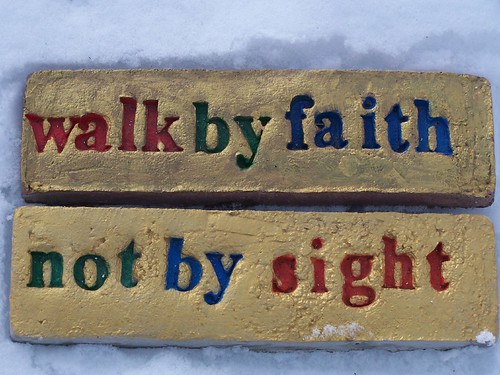
Walk by Faith

American Idol judge Simon Cowell is also the creator of a show called Britain’s Got Talent. He wasn’t having a good day at auditions this past April. “God this is horrible.” He said before the show went to break. When it came back from commercial, Simon was greeted by a middle-aged lady who looked… well, like nothing special. Susan Boyle looked homely and she’s from nowhere special. Simon immediately dismissed her, but since he had to talk to her, he punctuated all his questions with eye rolls, shrugs, and a body-language that said “Oh please.”

How many of you have heard Susan Boyle sing? Was it what you were expecting? [Watch the video here]

Susan sang. The crowd went NUTS for her singing and the judges just stared at the song bird that landed on the stage. Simon… well not just Simon, everyone was expecting failure. It’s the oldest sin in the show-biz book, judging a book by its cover.

In today’s scripture we hear one of Paul’s greatest pieces of wisdom, “We live by faith, not by sight.” Susan Boyle is the embodiment of this phrase. She showed a sexist, ageist, fashion-concerned world what it means to live by faith. In her short 90 second performance, she offered a one woman antidote to all the cynicism that had engulfed the world during this recession. She wasn’t a greedy banker, or corrupt politician. She wasn’t in this for fame or fortune. She had no interest in being another celebrity or raking in piles of cash. She had spent her entire life dreaming of being a professional singer and she had faith that she could do it despite being the full-time care-taker of her mother, despite not looking the way the world expects, despite never going 60 miles from her hometown; Susan had a gift and she had confidence in this gift. She knew it would take her places beyond her wildest dreams. She walks by faith.


We’re steeped in a world that loves what it sees. We are in a world that lives almost exclusively by sight. My college degree was in advertising, so I was set to make my career selling things to you all by sight alone. Doctors Michael Brower and Warren Leon state that “The average American is exposed to about 3000 advertising messages a day, and globally corporations spend over $620 billion each year to make their products seem desirable and to get us to buy them.”

Living by sight means that you have to have the new product, wear the deodorant that gets you the girls, but make sure that you’re wearing the right clothes, driving the right car, and completely defining yourself by appearance. If the world was like advertising would have you believe, then one paper towel can hold a bowling ball. The Eiffel Tower can be seen from any window in Paris. Household cleaning products hold the key to personal fulfillment. Medieval peasants would have perfectly straight teeth. And if you buy this SUV, you can take it off-road, it will never get dirty, and you’ll never drive in traffic, ever.

Living by sight is SO limited because we so often get it wrong. We misunderstand or misinterpret things which are right in front of us and get too concerned with just staying on the surface of what we know. Here are some examples:

In the year 100, Roman engineer Julius Sextus stated “Inventions have long since reached their limit and I see no hope for future developments.”

In 1893 a journalist wrote “Law will be simplified over the next century. Lawyers will have diminished and their fees will have vastly been curtailed.

In 1895, a teacher wrote to a father of one of his students that this student… this Albert Einstein “will never amount to anything.”

In 1949, a computer scientist stated that “It appears we have reached the limits of what is possible to achieve with computer technology.

The head of the patent office in the 1960s wanted to close up shop because everything had already been invented.

I could go on and on. The world is chock full of examples of living by sight.
So how does this concern you? When you pick up your paper or watch the news, it’s easy to fall into despair. Shootings at the holocaust museum, global warming, war, famine, bail outs, company layoffs, the list goes on and on. Paul is seeking to remind us of where we get our purpose and direction from. Sight, Paul argues, is the surface layer; faith is the insight that gets below the surface to goodness, truth, and love.

However, living by faith and sight can be done at the same time. Sight and insight operate together as they do in looking at a painting, where we see not only the forms and colors of the scene but also its beauty. To see beauty, it takes insight. It’s easy to see the beauty in the Hollywood actor or actress, much harder to see it in Susan Boyle or our neighbors. That takes insight. Beauty is something which cannot be measured or completely understood, but we know it when we see it through our insight, through our 6th sense which is our faith.

Walking by faith does not mean that we walk entirely in the dark by a kind of blind trust. It doesn’t mean taking what the bible says, what authorities say, what institutions say literally and unchallenged. A struggle takes place. An interested investigation launched. Remember Doubting Thomas?

There will be times when we have to walk by the light of our faith with only the memory of the insights that were once clear to us. Walking by faith doesn’t mean that once you have an insight, that’s the final and absolute truth… no. We as Christians believe in the Holy Spirit and the Spirit moves and guides and changes and challenges us and provides us with new insights… some of which contradict the old.

Walking by faith is asking questions and questioning the answers. This form of inquiry in many ways resembles the scientific method. But science fails to address such important human concerns as sorrow and joy, suffering and love.
Walking by faith doesn’t mean you’re standing still. Resting on old answers. When we walk by faith we follow the Spirit and Christ. Jesus walked the walk.
He was born out of wedlock. He hung out with the wrong crowd. He was from some backwoods town and couldn’t possibly amount to anything. He was put to death in his culture’s most shameful way and yet here we are 2,000 years later still talking about him, calling him the Son of God.

Walking by faith takes a lot of courage and effort and many just don’t want to do it. But there is power in it. It is a power that the world doesn’t really understand, not really, because there’s no guarantee. In fact, it actually looks like losing. The power of walking by faith is a paradox; it’s power that looks like weakness. More than that, it is not guaranteed to stop all evildoers. It might, of course, touch and soften their hearts. It enables you to recognize God’s power positively at work in the world.

This way of living comes at a price. It can leave us with the sense that we don’t know the answers after all, that we are much further from knowing than we’d ever realized before. This humble way of living shows us that there are many more angles by which to examine life than we ever imagined. As the ancient rabbis said, “Those who say they know are much further away from the answer than those who say that they don’t know.”

Take care to distinguish between externals and internals. Question your snap judgments and check to see if they hold water. If it looks like a duck, quacks like a duck, and swims like a duck externally, internally that duck may think it’s a flying tiger or a Tyrannosaurus Rex. That frog maybe a prince in disguise. Just like Susan Boyle who looks as plain as the day is long, but inside has the voice of an angel. Jesus, who looked like a backwoods carpenter well he’s divine. He’s the way, the truth, and the light. AMEN.

Thursday, May 07, 2009

Crisis (Elevator Version)

i used to think people were inherently capable of more good than they are. some recent experiences brought this to mind. i no longer believe in altruism. i think at some level, it all comes from a sense of self... some selfish notion is at play.

this isn't inherently evil nor is it inherently good. however, it usually leads to bad and if unchecked, even the seemingly good acts are bad.

does this come from original sin? no. it's how we're built. for every action there is an equal and opposite reaction. so if God created and claimed creation was good, then there was an opposite reaction which was evil. or think of it this way, a big light casts a big shadow. same with humans, we are beings of light and shadow, it's just easier to cultivate the shadow side.

i think a big mistake would be to deny the inherent evil that exists in humans but it's also another mistake to say the inherent good is not there either. people put bullets into other humans and they also jump in front of bullets for one another too. to say that this is because someone ate a fruit or talked to a snake is craziness. it's a mistake to think about why there is evil in the world or that there ever was a perfect earth. there is and has always been suffering. it's how you respond to it that counts.

Tuesday, May 05, 2009

Existential Crisis

originally written before the birth of Eve.. updated today, but i think it still serves... read and comment please!

the definition: Existential Crisis: a perceived sense of harsh confrontation experienced when a human confronts questions of existence and a change in one’s subjective perception their relation to their world.

the history: When i came into seminary i largely held a Palagian view of humanity.. mainly that had capacity to do good through reason and logic. when confronted with the truth, a person would adjust and change accordingly.

the opposite view of this is Augustine, who's view christianity has largely adopted, which is: argued that fallen man still has a free will (liberium arbitrium) but has lost his moral liberty (libertas). The state of original sin leaves us in the wretched condition of being unable to refrain from sinning. We still are able to choose what we desire, but our desires remain chained by our evil impulses.

Pelagius argued that Augustine's doctrine that humans went to hell for doing what they could not avoid (sin) was tantamount to the Manichean belief in fatalism and predestination, and took away all of mankind's free will. Pelagius and his followers saw remnants of this fatalistic belief in Augustine's teachings on the Fall of Adam, which was not a settled doctrine at the time the Augustinian/Pelagian dispute began. Their view that mankind can avoid sinning, and that we can freely choose to obey God's commandments.

the problem:: recent events have shown me that people are happy to be stuck in their situation... some people won't choose to get out of the situtation when the evidence is presented to them as they are comfortable with the pain. sort of like "the devil i know is better than the one i don't" sort of deal. this is highly frustrating. my high view of humanity has taken a large hit.. reason and logic won't always win the day.

it was pointed out to me by two great friends that i'm largely thinking of this because i'm bringing a child into the world. i'm pondering what sort of world this is. what is the core nature of humanity?

where I'm at now: I think a balance needs to be struck. Humans are limited and sin is a very real and universal state of humankind. I can see why one would believe the doctrine of original sin but I feel that this invites too many illogical support systems that need to happen. First a semi-literal interpretation of scripture is needed and belief in a shalomic state of being was intended. There had to have been a “garden” in which to fall from. This is inconsistent with science and serves no purpose. All it does is try to fit God into a human notion of good.

However, I’m not as confident as Pelagius was in human freedom and capacity to do good. I think humans do good when it serves their self-interests or interests of their group. This is not inherently sinful as Augustine would have insisted, but it does need some work. We need to see how we are connected to everything! We are entangled in relationships with other humans as well as our environment and animals that exist in that ecosystem. We are quantum entangled on a molecular level as well.

Quantum entanglement is a possible property of a quantum mechanical state of a system of two or more objects in which the quantum states of the constituting objects are linked together so that one object can no longer be adequately described without full mention of its counterpart — even though the individual objects may be spatially separated. This interconnection leads to non-classical correlations between observable physical properties of remote systems, often referred to as nonlocal correlations.

In short, we need to take our biological response for self and group-preservation and widen it to incorporate those who do not look or act like us.

Can Original Sin serve today? I don’t see how it can; there are too many additions one must add onto this doctrine to make it scientifically viable. It simply doesn’t fit with biology or physics. It makes for a good story and a great logical set up for the need for Jesus in a closed model, but once science enters into the picture, the story falls apart.

more research must be done... but i cannot hold that Eve is just as sinful as me... i mean doesn't my experience count for nothing?! i got 27 years on the kid! she's no more sinful than a snowflake. she will be living in a world where it's easy to learn this behavior.... so what i guess it boils down to is Freedom is a Pain in the Ass.

Thursday, April 23, 2009

Grey Area

a man walked up and said
"i've studied the scriptures and i need to decide,
my grandma so recently dead,
what happens when we die."

now i'm a skeptical man,
who thinks the grey areas should be mined,
i said "i dunno, but maybe so,
things tend to turn out fine."

this man, a scientist and all,
said "show me evidence of your find."
"what good is evidence," I said in reply,
"when aeronautics and science can't say,
why a bumblebee should fly."

i cannot tell you nor should i say,
it is up to you to decide whether
from what you feel and what you know
if there's an otherside, and if we'll be there together.

now he's a skeptical man,
no grey areas are fine,
everything must be backed up
every reason to the rhyme.

he said he concludes
life is linear like a horizontal line,
from birth to death with no deviation,
where it stops on a dime.

that's a perspective but for me
i must disagree
i simply don't see it so
each life is a raging river
each with an ebb and flow
and everyone reaches the sea.
for life is concentric circles,
and this here you can test,
that reality defies categories
and each circle is enmeshed.

and the wind when it blows,
it's older than Cairo,
more ancient than the sands,
or our joy or our sorrow.

and from this talk well he just walked,
but got to thinking...
of all the truth and what's the use,
what's worth believing?
since all our lives can't be verified
is truth still worth seeking?
life's not a test but still do your best
search for ideas worth keeping.
and when we die we might just fly
all along on the wind that's breeze'n.

Wednesday, March 25, 2009

Trees and Quantum Entanglement

Today was a sad day for my field education site. Trinity lost a pillar of their community this past Sunday and the community came out today to say goodbye. I had only known John Hess for a few months, i was blessed to meet him.

John Hess had a non-anxious presence. He had an easy manner, attentive. Around him, I really felt my youth, yet sitting next to him, I had the sense that things would work out. I think the best way to describe how I experienced John in these moments would be like this:

John is like a solid, old, and wise oak tree. Firmly rooted and watching, taking it all in. I was like the jittery squirrel scampering around. But it was in John’s presence, his shade, his branches that I found stability and I would think his family and friends would agree.

You may pass trees every day of your life, they’re unmoving and they don’t attract too much attention… but you notice when their gone. I’m happy to have noticed him while he was here. Trinity sure did. During the good times and bad times, John was there through it all. John was a pillar of this community that won’t soon be forgotten. I’m thankful for my short time with John. I am happy and blessed to know that there are such men in the world as John Hess.

Pastor Nancy talked about how we humans get confused and think that stuff and money are wealth. They aren't. Wealth is measured in relationships and memories. It reminds me of Wilco, when they sing on "Jesus Etc" that our love
our love
our love is all we have
our love
our love is all of God's money
everyone is a burning sun


we're all entangled. we're at the molecular level, through Quantum Entanglement and economically, emotionally, and any other way. the people we meet on the street, on our blogs, all are burning suns. we are colliding all the time with people who give light to the universes of their friends, relatives, children, and sometimes, sometimes we get glimpses of this light.

let your light shine! collide!

Tuesday, March 17, 2009

Cussing where appropriate

okay.. y'all should know two things about me. i LOVE NPR's RadioLab and i also like to cuss. it's something i'm working on, but i really can't explain things any other way sometimes. i really need to start reading the dictionary or something...

well imagine my surprise when RadioLab cussed! my two loves found each other! this caused a minor uproar, so i decided to send an email:

Dear RadioLab Email Reader,

I LOVED when Jad said "bitches" at the end of one of the segments of "Choice." Jad had to defend himself (was it on the Obama Effect?) and cited "generation" as his defense and he apologized. Although his apology was nice, Robert wasn't buying his reasoning. I will stand up to defend him. I LOVED it! As a 27 year old, I was right there and felt happy that RadioLab was in touch with the culture. It's why I listen to the show.

Here are two proofs to show that "Bitches" is part of my generation, I'll resort to some nasty means: Paris Hilton. She must be a listener or Jad is.. but I don't want to assume.
Proof 1:
http://www.funnyordie.com/videos/64ad536a6d/paris-hilton-responds-to-mccain- ad-from-paris-hilton-adam-ghost-panther-mckay-and-chris-henchy

Proof 2:
http://www.funnyordie.com/videos/06ae3d8563/paris-hilton-gets-presiden
tial-with-martin-sheen-from-paris-hilton

Thank you Jad, for reaching out to the neglected twenty-something crowd.
Bravo!

And I must say RL is my all time fave show on TV, radio, and pretty much anything else. I even used y'all in a sermon I gave at my church.
I hope I did y'all justice: http://toothface.blogspot.com/2008/12/god-in-unexpected.html

Peace, bitches!

-Luke


AND THEY WROTE BACK!!!

Thanks, Luke. I'm now imagining Paris Hilton listening to Radio Lab.

Jad appreciates all the support in these difficult times. Thanks for listening.

Best,
Emma, Radio Lab


yup.. that confirms it. i'm a RL Nerd. a label i'm happy to own!

Sunday, March 15, 2009

For everything there is a season

Science is finding out new things about time. Humans have been interested in time for as long as we’ve been writing. The writer of Ecclesiastes reflected on time just as our modern scientists are doing today. What the writer, these scientists, and we gathered here at Trinity know about time is that it doesn’t stop.

And, I don’t know about you, but I’m angry about this.

I’m angry that time stretches out for an eternity and it will not stop for me, and I’m assuming you are too. We only get a fraction of eternity. Time keeps on marching on and we’re all too aware that it will one day leave us behind. Time takes away our childhood, our pets, and eventually us. And there are no two ways around it. We human beings are in time; we're defined by its limits. But from the midst of time we have a sense for eternity. We have inklings of something more. All we get are glimpses of this place. Every now and then we see that there is something more beyond just us, our watches, calendars, Blackberries, and history books. We’re frustrated by our mortality and Lent and Ecclesiastes don’t help that feeling. We hate being reminded of how short our lives are.


We humans run around stressed out about time. There should be more time! We have things to do, things to accomplish, goals to reach, more money to get because we have more things to buy. We are a funny bunch. For everything there is a season, so says the wise writer of Ecclesiastes, but we wish that weren’t true. For some of us who are happy, we’re guilty about that and think we should be sad. For those of us who are suffering, we think we should be happy, so we don’t offend those jerks who are content. If we’re poor, we want to be rich… if we’re rich, we could always be richer. It’s all overwhelming! So much to do! And death is always just around the corner; it could sneak up on us at anytime. And there should be someone to protect us from death, but this person, this, GOD, isn’t doing their job.

We sometimes get an image of God as some sort of divine air traffic controller, choreographing all our takeoffs and landings, responsible for everything that happens to us. But when we find ourselves in the wreckage of one of life’s crashes… we often wonder if the giant air traffic controller in the sky is napping, negligent, or just plain mean.

But God is not protected behind glass, high in a tower above us, manipulating the world on a divine computer. We are not separated, God is here with us. I think I can only describe this through means of camp legend of a boy’s rite of passage into manhood.

The father takes the son into the forest, blindfolds him and leaves him alone. He is required to sit on a stump the whole night and not remove the blindfold until the rays of the morning sun shine through it. He cannot cry out for help to anyone. Once he survives the night, he is a MAN.

He cannot tell the other boys of this experience, because each lad must come into manhood on his own. The boy is naturally terrified. He can hear all kinds of noises. Wild beasts must surely be all around him. Maybe even some human might do him harm. The wind blew the grass and earth, and shook his stump, but he sat stoically, never removing the blindfold. It would be the only way he could become a man!
Finally, after a horrific night the sun appeared and he removed his blindfold. It was then that he discovered his father sitting on the stump next to him. He had been at watch the entire night, protecting his son from harm. We, too, are never alone. Even when we don't know it, God is watching over us, sitting on the stump beside us. Just because you can't see God, doesn't mean God is not there. When trouble comes, all we have to do is reach out to God.

We walk by faith, not by sight. Our faith is hard and it is questioned all the time. Some would like to tell you that once you become Christian, the road will become smooth. But it isn’t. Our lives are like a bumpy road. We sometimes find ourselves in a pothole that’s in a bigger pothole! Our faith then, tells us where we’re at. It tells us whether we should be trying to get out of a pothole or watch out for that curve up ahead. Our faith tells us to take note of where we are. Our faith tells us to notice what season we’re in.

For everything there is a season, and a time for every matter under heaven. Whatever season you’re in, God is with you. If you’re in the winter of your discontent, if you’re sick, in a troubled relationship, in mourning at the death of a relationship, God is just as much with you as if you were in summer. Ecclesiastes’ answer to all of our limited, short, crazy, chaos-filled lives is to be content and enjoy ourselves as long as we live. Ecc 3:13 says we should enjoy God’s gift, we should eat and drink and take pleasure in our toil. This can be hard sometimes because Chaos keeps coming into our lives. And even time itself is relative.

Einstein taught us that for each person, time passes at different rates, we perceive time differently. If I had a watch on, and Pastor Nancy had a watch on and she happened to be going at the speed of light, her watch would have a very different time on it than mine would. That’s an extreme example, but I bet if we took a poll of the congregation, not even four of us would be in the same season, the same time of our lives. Some are grieving over the loss of a job, some are fearful about their future, some are anxious, awaiting news of a diagnosis, and some are excited to bring new life into the world. We are all in different seasons, different times, and Lent asks us to take account of what season we’re in, with no layers over our answer, just a stark and honest look at ourselves amid the chaos. And there is always chaos.

Scripture states that God created the world out of chaos and it keeps breaking back into creation and causes havoc with our order. God took a great chance with this beautiful creation that surrounds us. Our parents took a great chance at having us because they knew chaos is dangerous. Chaos destroys the created. But the creative order itself is creative. Creation keeps changing just like the seasons keep rolling along, each one similar, but not quite the same. Everything changes, the world is sand. But blessed is the person who realizes this and creates anyway. To reframe a parable, blessed is the one who builds on sand knowing what will happen, than the one who builds on rock thinking it will last forever.

This is the nature of being creative amidst the chaos of the world. God didn’t design the chaos any more than we did. The chaos is what it is. The miracle is that good and beautiful things can happen even in the midst of it. All of our art and music IS designed to bring truth and beauty and yet it can bring wrenching tears. The children we decide to bring into the world to share in life’s joy will also share in life’s sorrow. The friendships we create will bring great joy, but only at the risk of causing real pain from time to time. Seasons change. And for everything, there is a season, a time for every matter under heaven.

That’s the secret of Lent and Ecclesiastes. It’s the secret that our pets know, that I learned from the book Marley & Me. A dog or a cat does not care if you're rich or poor, educated or illiterate, clever or dull. Give them your heart and they will give you theirs.

The secret is that in the "less" there is "more." The less we obscure what is truly important with bitterness, animosity and cynicism, with striving for the next goal, for checking off the next box on your life’s plan. Lent and Ecclesiastes ask us to be more aware of the promise of possibility and new life. They remind us that every single day of our lives, we are asked to walk in the way of love over hate, courage over fear, and hope over hopelessness. Do not dwell in the past; do not dream of the future, concentrate your mind on the present moment, no matter what season you’re in. Give God your heart, and you’ll find God has loved you always.

Works Cited
Scott Hoeze’s sermon "Setting Eternity" found at http://www.calvincrc.org/sermons/topics/ecclesiastes/eccles3.html

Paraphrase of “Parable” by Joe Pintauro from the books Kites at Empty Airports.

Theology for Preaching: Authority, Truth and Knowledge of God in a Postmodern Ethos by Ronald J. Allen, Barbara Blaisdell, and Scott Johnston pages 80-85.

Paraphrase from Marley and Me by John Grogan

Reverend Bill Federici, from an email about Ash Wednesday and Lent

BENEDICTION! (dvd extra)

And here’s another secret. It’s a math secret. Our fraction of time that we spend here on earth is a little itty bitty piece of infinity. If you take “forever” and divide it in half, it’s still forever. Divide that half by 3/4, it's still forever!This is good news as we believe in being part of forever! Time is infinite and we get but a fraction of it in our earthly form, and then our season changes and we go onto something else. Jesus assures us that we should fear not! For in his Father’s house there are many rooms! So take note and own where you are at, what season you’re in, and live fully into that season. Take joy that you get all of time, all of forever, and you get to enjoy it in many forms, in many seasons of life and thereafter. What a joy that we all may be in different seasons, but we get to share this time together.

Go forth and be reminders of this message of eternity in the name of our Creator, Sustainer and Redeemer. AMEN.

Thursday, February 19, 2009

Bias & Culture

pulling largely from a lecture given by Nestor Medina here at LTS, i think it's time to talk about Bias and Culture.

lots of talk about culture, but how best can we define it?

there's many ways, i'll attempt to define it here and then discuss what it means to COEXIST.

Culture is 1. a sum total of rules that shape belief, communication, and thinking, 2. refers to particular ways of thinking, acting, and organizing aspects of housing, technology, art, family dynamics, and science, 3. gives coherence and totality in relation to the rest of the world and is transmitted from one generation to the next.

or as my Giradian buddy Bryce would define it: culture is what keeps you from retributively killing people.

example of two cultures coming together: A Danish man and Egyptian man go to play a game of billards. When asked (by a third party) how good they are at billards the Dane replies "I've played before" and the Egyptian replies "I'm very good at this game." Both exhibit their culture... Danish culture values humility where Egyptian culture values embellishment. Imagine the surprise and potential conflict when the Dane throughly thrashes the Egyptian.

now based on these definitions and this understanding of "culture" i would say that one cannot get outside of one's cultural bias. here are some ways of thinking about culture historically in terms of one's "Holy Scriptures" according to the Medina lecture:

Acculturation: Taking a book from another culture and placing it in one's own: i.e. the Bible is Angelo (although it was written by the Hebrews amid their pressures from Assyrian, Babylonian, Greek and Roman Cultures). or as Yael pointed out, the Christians claiming the Torah as THEIRS but largely ignoring and dismissing it.

Enculturation: Our way of thinking is the best! The Qu'ran is Arabic therefore one must be Arabic to be Muslim or the Gospel is Angelo Culture, therefore one must become Angelo to be Christian. This is a false assumption and we've seen the effects on the world in missionaries and Colonial though processes.

Inculturation: Use resonate images to convert other cultures. You guys believe in charity? WE DO TOO! Here's where our scriptures are doing what y'all already are. This is apologetics and falsely thinks that the scripture can be removed from the culture.

Interculturation: Naming own culture specifically and seeing the positives and negatives. i believe this is the best way. when we talk about things, it's best to say "As a white, progressive Christian i see this issue this way" or "As an atheist woman" or "as a Muslim from Egypt" here it helps either party figure out how best to frame the interaction and the friction that occurs from both parties involved.

this is important to do as we're making assumptions about the other... what we should do is to name our assumptions from the get go, question the person we are in dialogue with, and let the "other" fill in their own blanks. for example, when coming to me and knowing that i'm a christian, don't think i'm a creationist, or think the Bible is THE word of GOD, or that i send other faiths to hell. i don't hold either belief as i believe in evolution and that the word of God is in the Bible amid the cultural bias and baggage.

Sunday, November 30, 2008

Santa’s Occupational Seasonal Disorder

Sermon given at Trinity 11-30-08, first Sunday in Advent: Text was John 1:1-16.

I’m member of a special envoy sent to you to talk about Christmas. Yes, Christmas. This is the first Sunday in Advent, can you believe it?! Well I should introduce myself, my name is Jingles, and I’m an elf. Not what you were expecting was it? Maybe someone a little shorter, dressed with some curly shoes and tights with stripes? Ugh, you humans and your stereotypes… but I promised my boss not to get carried away on that issue, but needless to say picture tall elves closer to Lord of the Rings than the short kind you’ll see on the upcoming Christmas specials.

And here’s another preconception I need to address, I do not make toys for a living. In fact I hold a doctorate in psychology from North Pole University (Go Polar Bears!), and I work as Santa’s therapist. As a favor to the boss (Pastor Nancy and he go way back), I’m here to talk to you all today about how to handle holiday stress. As we’ve heard from today’s reading that the WORD became flesh today... The Greek word for ‘word’, you know, The WORD BECAME FLESH is LOGOS. This word can also mean logic or intelligence. John loves these double-meaning Greek words so this passage says that The WORD/LOGIC became flesh.

It’s interesting that John starts with this idea for Jesus’ coming into the world because the celebration to commemorate this event is the time of the year when everyone loses their righteous mind. The story of Christ's birth is a subversive story of an upside-down kingdom. It's a story of promise, hope, and a revolutionary love that is still changing the world to this day. So, what happened? What was once a time to celebrate the birth of a savior has somehow turned into a season of stress, traffic jams, and shopping lists. And when it's all over, many of us are left with presents to return, looming debt that will take months to pay off, and this empty feeling that we somehow missed its purpose. The same is true for Santa… let me tell you his story.

Before Santa was Santa, he was Bishop Nicholas of Myra who was famous for his generous gifts to the poor. Well, Nicholas being a saint he decided to widen his outreach. His business grew and grew and he had to relocate to the North Pole, but the vision was still the same. He was following in Jesus’ footsteps and bringing hope to the poor and presents for the little children. After all, Jesus loves the little children and St. Nicholas does too. Soon St. Nicholas became a world-wide phenomenon. With this new celebrity came new challenges.

He had a supply and demand problem, so he came to my oppressed people, the elves who are known for our craftiness and high production output. In fact, that’s why we had to move because all of the economics couldn’t handle how fast we could supply things! So we relocated to the North Pole and were quite happy with the deal. Since St. Nicholas was a saint, we soon adopted his religion and we have North Pole bible studies and churches, just like you guys do only with the benefit of having a recognized saint lead worship.

Santa also had a logistical problem of how does he get all around the world in a night? That’s where the flying reindeer came in. It all started clicking together and there were many years of great success. But like any celebrity, there’s a down side to fame.

People forgot Nicholas was religious, not only religious, the guy’s a saint! They called him Santa and forgot the religious ideals he stood for. St Nicholas also didn’t keep the rights to his image and that’s how businesses can use him to hawk their goods for them and appear at malls and not churches. All this was really hard for St Nicholas to handle.

He mirrors some of our highest ideals: childhood purity and innocence, selfless giving, unfaltering love, justice, and mercy. (What child has really ever received coal for Christmas?) The problem is that, in the process, he has become burdened with some of society's greatest challenges: materialism, corporate greed, and domination by the media. Here, Santa carries more in his baggage than toys alone! He has what we professionals call “an occupational seasonal disorder.” Meaning at the same time, every year, he gets really depressed and stressed out about all he has to do during the holiday season. I bet there are a few in this room I could diagnose with this, too.

Is this what we really want out of Christmas?

What if Christmas became a world-changing event again by turning our focus back to the birth of Christ? What could happen to your family if this focus was celebrated in loud, bold and totally unexpected ways? What if you could actually trade your season of stress for a season of celebration and unbelievable memories with your friends and family? What if all of this could save a life at the same time? It can.
It starts with Jesus. It ends with Jesus. This is the holistic approach God had in mind for Christmas. It’s a season where we are called to put down our burdens and lift a song up to our God. It’s a season where love wins, peace reigns, and a king is celebrated with each breath. It’s the party of the year. Entering the story of advent means entering this season with an overwhelming passion to worship Jesus to the fullest.

Plus there’s a biological benefit, not just a theological aspect to becoming de-stressed. Robert Sapolsky is a behavioral biologist at Stanford and is the leading expert on stress. He did a study on stress hormone levels in rats. He would leave them out in extreme conditions, do all sorts of nasty things to these rats and measure their hormone levels. He then found these same levels in just “frustrated rats.” If he showed them food and then denied them it, the levels of stress hormones in the rats would be equal to those whom he left out in the cold or put in a dire situation. So when you get really stressed out this holiday season over that burnt yam or that you can’t find a gift for Aunt Mildred, or whatever causes you stress; the level of stress in your body is same as if you were being chased across the North Pole by a hungry polar bear. So if NOT doing something helps you lower your stress level, by all means DO IT! If that means shopping online, or not shopping at all, or whatever it is, do what makes you the least stressed.

Before you think I’m getting all Scrooge on you, let me explain what I mean. We like gifts. Our kids really like gifts. But consider this: America spends an average of $450 billion each Christmas. How often have you spent money on Christmas presents for no other reason than obligation? How many times have you received a gift out of that same obligation? A Gift you had to return or figure out what to do with.

Consider buying ONE LESS GIFT this Christmas. Just one. Sounds insignificant, yet many who have taken this small sacrifice have experienced something nothing less than a miracle. Or even in lue of a present, write a kind note and let people know you’re thinking of them. And think of how many presents Jesus got on his birthday. How many? Three! How many gifts do your children get? Are they the messiah? Well, now I’m forgetting myself, anyway, that’s just some food for thought.

Here’s another thing that bugs ol’ St. Nick. Every year he has to go through the same old routine and traditions… Mrs Claus gets stressed because she has to cook these huge meals for everyone, St. Nick has to deck the halls and make sure all the lights are strung up, not to mention all the traditions the elves and reindeer have grown accustom to. You prolly have these same holiday traditions that started off great but have turned into expectations that act as more of a stressor of getting them just right than actually helping you get into the spirit. Here’s another thing I tell Saint Nick and I’ll tell you… don’t do them! If a tradition is causing you more stress than celebration, it’s not worth it. If that means the Christmas cards go out later rather than sooner, or you don’t go a-wassailing, or those chestnuts aren’t roasting by an open fire, it’s no big deal! Hey! Jesus is already born and Christmas is going to happen whether these routines are done or not.

Didn’t Jesus come to say that mindless routine is not really worshipping God? Christmas is a time of joy, of family and friends, of remembering the birth of a small babe, born to a poor family, who grew up and changed the world. Jesus came to say “routine isn’t important, relationships are!” focus on those relationships this holiday season, gather memories and not debt.

Let’s not lose sight of the promise of Christmas. Spend less, love more, and worship more fully this holiday season. Keep your Logos, your rational mind, as you’re part of the logic, the word that became flesh.


Works Cited:
much of this sermon is lifted directly from Advent Conspiracy which is just a wonderful resource.

Robert Sapolsky. Why Zebra's Don't get Ulcers and also on RadioLab's Stress show.

Tuesday, October 14, 2008

Creation Theology In Jurassic Park

Just finished watching one of my all time fav. movies, JURASSIC PARK! I noticed something.

there's quite a bit of creation theology being thrown around here.

Dr. John Hammond creates life, life that's been extinct for 65 million years. He thinks that which his power in science and technology will keep him safe. I notice here that Hammond acts a lot like the God in the 2nd creation story (Gen chapter 2). He even kinda looks like God with the white beard and clad all in white (not to mention the scottish accent! my Aunt Deb was right!)


Dr Malcom on the other hand, sees what's going on the first few minutes of the film when he laments "God help us we're in the hands of engineers." There's a problem to thinking that if we have the right order, all will be taken care of. If we place our trust in the right system, we'll be safe. No system can contain life's chaos.

This simple fact here shows me that there is no perfect state, no shalom, that the world wasn't ever supposed to be lived in the Garden. That is better left to myth. As Dr Malcom puts it "If there is one thing the history of evolution has taught us it's that life will not be contained. Life breaks free, expands to new territory, and crashes through barriers, painfully, maybe even dangerously."

I really should write a book about this, but who has the time ;-).

*******************************************
What does relaxation look like, here my dog Sonny showing yous humans how it's done! Thanks to Essie for watching him while we were in DC and for snap'n this shot.


Greyhounds rule!

Monday, June 16, 2008

Created Reality

I love the TED talks. Amazing stuff over there. Run over there and check it out.. i've watched a TON of things but i would like to know what strikes your fancy. let me know!

here's my big rant for today based on two TED talks. How do we create?


Why am i this person? why am i not someone else? I would prefer to be a Japanese heiress, why am i a white American from Ohio?

what Amy Tan talks about around 11 minutes is that we "notice disturbing hints from the universe that were always there." this is what i was talking about in the last post about Serendipity and synchronicity. we strive to gain our focus on the question "Why am i here?"

I have not read A Purpose Driven Life.. so i can't comment on that.. but i do believe that we all have internal blueprints and we have to follow and we get in trouble if we stray too far from these blueprints. Joseph Campbell's simple "follow your bliss" helps but we must be mindful of our bliss and our pursuit and what effect that takes on others. the question then of "why am i here" becomes a problem of big sorts, esp. if the universe is telling us in such obvious fashion. how can we miss such obvious cues?

the Christian answer is because we're fallen. The science answer is that our brians are miswired. Either one points to the fact that humans are limited and flawed.


i'm not in the Sinner Theological World... so i don't really buy the "inherently and permanently no good" of the original sin doctrine. i think that once we gain our focus, we can overcome a lot of flaws inherently built. God is helping in this process the whole time, helping us to wake up and become who we are and who we're meant to be.

In the book, Nudge: Improving Decisions about Helath, Wealth, and Happiness Richard Thaler and Cass Sunstein points out how weird our brains actually are. Humans are very illogical: we eat more from larger plates, care twice as much about losing money as about gaining it, fret over rare events like plane crashes instead of common ones like car crashes. We need what Thaler and Sunstein call a "libertarian paternalism" that lure us to make the right choice. our brains are really weird.

but what about trauma? what about those events that happen to us that are SO traumatic that we will never get over them? things like rape, abuse, oppression, dehumanization... what about those things? these are results of what is attached to our memory. what is memory then? a collection of protein chains.

Neuroscience has discovered how we remember events in our brains through protein chains. An NYU neuroscientist Joe LeDoux, who studies fear memories in rats, tells us how with a one shock, one tone, and one drug injection, you can bust up this piece of matter, and prevent a rat from every making a memory. LeDoux’s research goes sci-fi, when he and his colleague Karim Nader start trying to erase memories. And Nader applies this research to humans suffering from PTSD. We heard about this when we were at Rolex in Lexington KY on the radio. Listen to it here! IT'S AWESOME! check it out, as this is the basis this post revolves around.

Particularly traumatic memories appear to be captured by two separate parts of the brain: the hippocampus, the normal seat of memory, and the amygdala, one of the brain's emotional centers. People incapable of forming long-term memories thanks to hippocampal damage can nonetheless form subconscious memories of traumatic events if their amygdala is intact. Someone suffering from the Memento condition would likely have a feeling of general unease encountering a person or a situation that had caused them harm in the past, though they wouldn't be able to put their finger on what was making them uncomfortable. In Eternal Sunshine of Spotless Mind, something like this happens. There are several instances in the movie where Clementine appears to have a trace emotional memory of an event that has been wiped from her waking mind.

Theoretically, if you could block protein synthesis in a human brain while triggering a memory, you could make a targeted erasure.

So not only does this show how we don't really remember who we are accurately, we don't preceive reality accurately, and we're generally in quite a state. once we realize this, maybe we won't be so hyper about disagrements. maybe the word HERETIC won't be a warcry anymore, but mean "to choose" like the greek implies.

this is post-modern thought. no memory is verifiably true. there is no objective reality only reality viewed from our context, with our prejudices and world view. or maybe there IS objective reality, but our brains can't handle it, misinterpret it, and ultimately misread it. so if there is objective reality, all we get from it are glimpses, small epiphanies. When we remember and view reality, it is an act of creation. Every thing we do is an act of creation. where then is God?

well Biblically this fulfills that we are active in God's creation that we are created in God's image (Genesis 1:27; Psalm 139:13-16). The apophatic tradition focuses on a spontaneous or cultivated individual experience of the divine reality beyond the realm of ordinary perception, an experience often unmediated by the structures of traditional organized religion or learned thought and behavior. so that place where words fail you.. that is God. can you describe what it was like the first time you saw the ocean? first time you fell in love? that indescribable part is where God lives.

The Divine is ineffable, an abstract experience that can only be recognized - that is, human beings cannot describe the essence of God, and therefore all descriptions if attempted will be ultimately false and conceptualization should be avoided (like using pronouns).

This is a super long post... with a lot of stuff in here for y'all to watch, listen to, and consider. so i'm gonna go on vaction here as i have to write my first sermon for my field education placement. so i'll let you catch up, please comment on what you think after you've listened and watched all this, and then we'll chat! i'll post next on July 1st.

Wednesday, May 28, 2008

All We Have is Now

Reflection on "Bowl of Oranges" by Bright Eyes or
"I am a Strange Loop and You Can TOO!"

While Scientists were mapping my insides,
i wandered into a lonely storm,
here's what i found:
there's no prayer i could say,
no advice i could take,
no pill that offered salvation,
no fountain to seek,
no cup i could drink.

i know of nothing that ever grew younger,
the universe goes on forever,
like two mirrors facing each other,
it's reality upon illusion over and over,
until you can't tell the difference,
they both blend together.

all we have is now,
all we have is you and me,
let is sit together here,
in awe of the strange loop we create,
and read the story in our fault lines,
and in our soil,
that is furtile with our own personal histories.

Tuesday, April 01, 2008

The New Testament Class


Dudes.. seriously.. you gotta get a book called The New Testament; A Historical Introduction to Early Christianity by Bart D. Ehrman. Bart also wrote "Misquoting Jesus" which i also highly recommend. why do i loooove this book/class so much? well it really helps bring into focus the historical world of Jesus. Here are some thoughts from the book:

Many christians today think that there was once ONE christianity in the first century and that the splits (i.e. the many denominations) of christianity are a modern invention. NOT so. There were at least 4 types, if not more. we had the Jewish-Christian Adoptionist that thought Jesus was not himself divine but his message was. Calling Jesus God was a blasphemous lie. They liked the gospel of Matthew and thought Paul was a heretic.

The Marcionite Christians on the other hand LOVED Paul and thought that Jesus was Divine and NOT human. Marcionites believed that the Jewish god was evil and Jesus came to save us from this god. Marcion (the leader) actually went further and put together a "canon" or standard books. Their bible was a shortened version of Luke and ten truncated letters of Paul with NO Hebrew Scriptures.

There were the Gnostics who believed that there was a special knowledge that is necessary for salvation. Salvation meant escaping from this material world. Jesus was fully human but yet was entered into by another entity known as the CHRIST at his baptism. therefore jesus was two beings. Gnostics were also polytheists believing that there were at least 32 different gods and some even believed there were 365 gods and each one controlled one day. They had their own writings, namely the Gospel of Thomas, Gospel of Mary, Gospel of Truth, and the GOSPEL OF JOHN. Yes, that's right, John is a Gnostic gospel.

Proto-Orthodox christians claimed that it's views had always been the majority position and that it's rivials (meaning all you've just read about) were heretics. They later became the dominant form. They accomplished this by taking everyone else's major gospels, namely matthew, mark, luke and john and claiming that these held the real authority. these christians argued that jesus was both divine and human and was one being instead of two. by accepting all scriptures as authorities they were able to claim that both perspectives were right and showed their emphasis was correct and that argue'n that Jesus was ONLY human or ONLY divine was a perversion of the truth.

so that's how the New Testament emerged, namely out of conflicts from these groups. and we've been debate'n the acceptance of what books should be in the bible ever since. there were some popular ones like the shepherd of hermas that didn't make it. Revelation was the MOST disputed book, but somehow made it in. It was not until the year 367 C.E. (almost two and a half centuries after the last n.t. book was written) that the 27 book N.T. canon was accepted.

another thing to think about is the gap between writing. Mark was prolly the first Gospel written about Jesus... it was written 30 to 40 years after the death of Jesus. This would be like having the first written record of the Eisenhower presidencey appear today. There is also NO written reference to Jesus or his followers in pagan literature toay from the first century of the common era.

crazy facts for a crazy world. now we don't have to say "i wanna go back to that one time christianity" when we never had it. even the early church set up was split between 5 major ancient cities. gotta love history, it's so crazy interesting!