Showing posts with label Christus Victor. Show all posts

Tuesday, May 04, 2010

The Christology of John 10:11-15

recently i posted Christological Categories and now i would like to show how these would go together while reading the bible. This is taken from my paper for class, i hope it shows how to use these categories as a means of interpretation.


The purpose of this paper is to explore the Christology in the passage of John 10: 11-15. I will explain how I will be reading this passage, what the basic image of Jesus is in the passage and how it makes me feel. I will then determine what doctrines of the atonement and person of Christ that would be compatible with this image.
Method
The method of exploring this scripture is a new one for me since coming to seminary. I will be operating on a purely subjective methodology that will focus solely on the image presented and my reactions to it. This means no looking into the literary analysis or putting the text through the critical method. I will be operating on a purely subjective methodology that will focus solely on the image presented and my reactions to it. This is to help focus my thoughts and feelings in a Lectio Divina style meditation on this passages and what associations it brings up to the readings that were assigned for class.
Thoughts and Feelings
            On my first reading of the passage, I felt secure, taken care of. I would hope to be in this flock and that I would be protected by this shepherd. Then I started thinking “What the hell kind of shepherd is this?! I don’t want the shepherd to die for the sheep; I want him to beat the snot out of the wolf with his crooked stick! Where was he during the wolf attack? Does he not interview well if the hired help runs away? Doesn’t seem like a good shepherd to me!” Then I started noticing the details of the story and image.
            Jesus is not just a shepherd but a “good” one. There is a hired hand there but he had no ownership of the sheep and ran away when trouble started. Jesus not only owns the sheep but cares for them as well. This suggests that Jesus is more than “just” a shepherd but THE shepherd, as this is a popular description of God and God’ relationship with Israel. The flock is scattered and a wolf has attacked, apparently not while the “good shepherd” was around but instead when the hired hand was around, who allowed the attack to happen and ran off to save his own hide. Unlike that hired hand, the good shepherd will lay down his life, meaning he may lose, but he will fight to the death. It doesn’t say that the shepherd will win against the wolf or that the flock will be brought together, but there is a sense of commitment and relationship between the sheep and shepherd.
            Jesus criticizes the Pharisees just before this passage for not being good leaders and bringing great harm to the people.  Jesus condemns them as bad shepherds – shepherds who hurt the flock. The Pharisees then, according the author of John, were these cowardly shepherds who wanted the wage but were unwilling to pay the price. I am taking ministerial ethics and this reminds me about spiritual abuse and how to cope with the damage spiritual leaders can leave. These abuses come from self-serving pastors with bad boundaries, or boundaries that only serve themselves. A spiritual leader who’s looking out for him or herself will not make sacrifices because it costs them something. It would be akin to a pastor getting rave reviews and having the people feel that they are cared for, but at the first sign of an external threat, like a financial crisis the pastor splits. Jesus isn’t looking out for himself, he’s looking out for us and so he makes sacrifices that cost him everything.
            When I understand the phrase in that context with those considerations, I am more open to it. I feel safe or at least safer in comparison to the hired hand. A tragedy has befallen the flock, a traditional metaphor for Israel and the leadership that was around at the time was not enough and proved to be self-serving. The owner is now gathering the flock and repairing the harmed caused. I imagine Christ as a shepherd knowing each of his sheep by name, checking each sheep at the end of the day, inspecting and bandaging all the places where they are wounded.  He remembers that and comes back to check and mend as often as they need it. This image is one of total care and protection.
Atonement and Christological Implications
            John 10 is a sacrificial model. It is pretty straight forward as it is said twice that the “The good shepherd lays down his life for the sheep” (15:11,15). To whom or to what and why is uncertain. Presumably to the wolf or maybe the whole life is spent tending to the sheep, and therefore that is what is meant by laying down one’s life. It could be said that pastors lay down their life for the wider church as that is what they will spend most of their life doing. In this understanding, postal carriers would lay down their lives for the delivery of mail to use another example. This would be akin to someone who would dedicate their life (give up in a sense) to a cause, like Saving Private Ryan, for example. I do not think that is what the passage is directly point to, although it is part of it.
            The problem is not that humanity needs to be bought back from someone nor that victory will be gained over the wolf. The sheep are the victims in the story as those who were hired to watch over the flock did not. The model fits with the “Classical” model (Barrett para 2). In this model Jesus’ death on the cross atones for human sinfulness. I initially thought that the Latin view the atonement would be made for the sins of the leadership/hired hand for letting the wolf attack the flock and scatter them and Jesus, like God, desires to maintain order and works to take away the sin that has happened (Barrett para 2). However, the hirelings run and are never mentioned again. It is purely for the sheep's sake (with no mention of the sheep's sin) that is the focus and the feeling is one of fighting evil forces, no reparations for sin. The sheep are known and wanted by their owner and this is a “compelling affirmation of belonging” (McGrath 8). The security is total while there has been an acknowledgement that tragedy has happened; the image given is one of dedication and security. Much like the picture On the Lawn by Amedeo Bocchi as described by Alister McGrath:
What is the broader context? Where exactly is the lawn? What lies beyond the picture’s margins? We have no idea. The threat of war may loom. Troops may be on the move. Economic recession may have gripped the nation. Yet here, frozen by the artist, is an image of personal security and acceptance. Whatever the context may be, this child is enfolded and protected. She is loved, accepted and wanted (9).
This is the same feeling I get from the passage. The people are experiencing their religious leaders as out for themselves, they feel taken advantage of, scattered and divided and used. Yet here is Jesus saying that they are wanted and that they belong to his flock and harm will not befall them again as he will lay it all on the line. In fact, Jesus is the ideal shepherd much like the images of God that can be found in Ezekiel as well as many Psalms (most notably Psalm 23). This would seem to point to the atonement theory of Anselm.
            In Anselm’s theory, a new relationship is forged between God and the world and it is God who acts as both the reconciler and the reconciled (Aulen 30). In this image, Jesus is not just the “Lamb of God that takes away the sin of the world” (John 1:29) but the Shepherd and therefore the fighter, the victor over the wolf, however, there is no mention of whether the wolf would be defeated or not, thus the metaphor isn't completely Classical, but more on this later.
              In John's understanding, God has come down and seeks to put together what humankind has torn apart. Jesus as the Shepherd, namely God, points to either an Antiochen or Alexandrian view of Christ. With Jesus using shepherd imagery and that image being closely linked to God, I believe rules out Ebionism. The reference to Jesus dying for the flock rules out Docetism as a bodily death must happen. Given that God tends the flock and would be an ideal shepherd, I believe this points more to an Alexandrian understanding than an Antiochen as the divinity of Christ would be the governing principle. The Antiochen model divides up the actions of humanity and divinity, so speaking about being a shepherd would be very human, but the long tradition of God as shepherd leads me to regard the divinity dominating the humanity of Jesus in this statement.  
Another Consideration
            The image in John is one of safety and security. It is one of gathering and reconciliation out of the love God has for his sheep. Jesus seeks to do what the religious authorities could not do (and what the Zealot, Essene, and Rabbinic movements also claimed). However, the image doesn't fully get the job done. So I do have another interpretation of this image if I take into account that the wolf could be a symbol for Rome. 
          In the myth of Romulus and Remus, a she-wolf suckles the boys who go on to found Rome. In this understanding, Jesus is protecting the flock, namely the simple agrarian farmers of the Galilee from the Romans since the Temple authorities could not protect from oppression and invasion. Jesus will give up his life for the flock while the hired hands run away. There is no concept or reference of the resurrection in this statement, although given the rest of John’s gospel it is implied in the narrative arch. This understanding is plausible as well yet changes the atonement model from sacrificial to the empathic model, where Jesus provides a powerfully moving manifestation of the extent and depth of God’s love for humanity (Barrett para 4). The Christology remains Alexandrian in terms, as the image of God as Shepherd is too strong to be ignored.
Conclusion
            I have explored two possible meanings for the image presented in John 10. I am normally drawn to Jesus as political revolutionary but challenged myself to explore another mode of interpretation. I find that both fit in this instance. While I prefer the political revolutionary, I see how the Christus Victor model cannot be avoided here due to the Gospel of John’s view that everything Jesus says or does is somehow related to his death. The laying down of the life can be interpreted as Jesus willing to go and fight and sacrifice himself for the good of the flock  or due to the fact that he knows that Rome will kill him for his words and desire to unite the flock against the imperial colonizers. Reading with both images in mind help provide a fuller understanding of how people can approach the same text and come away with different thoughts and feelings. This paper was fun to write and was a useful exercise. It has helped me respect the different Christologies.

Works Cited

Aulen, Gustaf. Christus Victor: A Historical Study of the Three Main Types of the Idea of Atonement. Eugene Oregon: WIPF & Stock, 1931.

Barrett, Lee. "Theories of Atonement (The Work of Christ)." Class Handout (March 22, 2010).

McGrath, Alister. Redemption. Minneapolis: Fortress Press, 2006.

Thursday, March 25, 2010

Christ as Sacrifice, Christ as Victor

In my previous post where i revealed how big of a heretic i am, i stated later that i would clean up some inaccuracies on my part. This is that later. This post will divide up the sacrificial model of Anselm and posit the real Christus Victor model. both models have their pros and cons, and i will cover both.

The image of Christ as sacrifice is super old, prolly one of the oldest. the images pop up many times in the New Testament, featured heavily in Hebrews but also in the synoptics. it is also in the early church liturgy yet notably absent in the Didache, which i find really interesting... but i digress.

while the Pirate tried his best to offer up helpful metaphors for me, my prof did one better and offered up a section of the movie Dead Man Walking.


there is a part towards the end where the convict confesses to the nun. he starts off with some bravado he has had the whole movie yet acknowledges that he was a coward and thus was a victim by this other bully. however, the nun gently presses him and he finally admits guilt and responsibility for his actions. the nun forgives and the convict seeks forgiveness and notes that while his life was no good, maybe it will finally be of some good as his victim's family may take some comfort in his death. it hurts the nun to forgive as she finds a connection with a soon to be dead guy and it will hurt to see him die. it hurts the convict as it completely deconstructs his carefully held and constructed identity as a tough guy.

here's the kicker: in the view of sacrifice, God would be both the nun and the convict. the cross is the symbol of the connection between human guilt and divine perfection, love and empathy and repentance. Jesus as both divine and human becomes the rep of humans who need forgiveness as sinners and God who needs to forgive the wrongs done. Hurts humanity and God and the anguish on the cross symbolizes that.

this metaphor i can support more so than before. it gets strange when we ascribe Jesus as a substitute for us, as that gets legally strange, but to see Jesus as symbol of humanity, a representative of us, then that i can buy into. this requires a notion of a corporate self which Anselm and the early church would be operating with, yet we here in the Western 21st century might not get... but maybe, there are some connections for us.

just think of it like the government or sports team. if the government declares war on our behalf, then we are at war as a whole, whether we agree or not. if you listen closely to sports fans, they'll say strange things like "We WON!" but they weren't even on the team! They id. so closely that the team becomes the symbol for the city and everyone in it.

what does this say about God? the incarnation is a must in this theory. many divergent theologians come together here and state that this doesn't make God angry or any such thing, but those like Paul, Karl Barth, and even Paul Tillich (with his uber-abstract God) states that God is loving and merciful.

so in this instance the cross = the fact that love hurts. pain is the price of being in relationship and we are called to participate in this love and grace NOT thank God we got a substitute and we're off the hook and we can just believe and be fine (and buy Hummers, screw over the poor, and benefit from other's hard work, while giving those outside our faith a really hard time). i like this because i am in pain often due to my relationships... i'm always screwing something up or saying the wrong thing. even on this blog, i take pains to speak to others both inside and outside my faith tradition. there's a lot of forgiving and reconciling that goes on at a regular basis around here. this process involves sacrifice on both parts... of time to write responses, of giving up or questioning long held assumptions... so i understand this better now than the other...

the other view being, Gustaf Aulen in Christus Victor states that Christ as sacrifice is completely wrong! Aulen is Lutheran and so he went back to Luther and found that Luther too, didn't like this view held by Anselm. while this view is also scriptural and early "creedal" church Aulen was the first to give it a name.

Christus Victor = Christ victorious over sin and death and the devil. that is the "package" plaguing humanity and we need liberation from. this is heavily dependent on the Fall, original sin, and the idea of an objective and personified evil. the whole problem with the world is that we are at war, life is conflict, a battle between good and evil, angels and demons. Everyone else is pushed around by evil until Jesus comes and conquers it.

the best film to convey this idea is Mel Gibson's Passion of the Christ. take note of this "garden" scene. I've never watched the movie and doubt i will, and if you haven't all you need to do is watch this:


this is the whole movie in miniature. Jesus in agony, the devil being creepy, and humans behaving badly (either chickening out like the disciples or being corrupt like Judas and the Sadducees, or violent like the Romans).  God needs to win back humanity as we are powerless to do it ourselves. So God disguises Godself and is "born to die" and the devil, being smart in all other things in the domination of the world, doesn't recognize God in human form. So when the devil goes to claim another tasty soul, BAM! it's God who kicks some ass, liberates humanity and rules supreme.

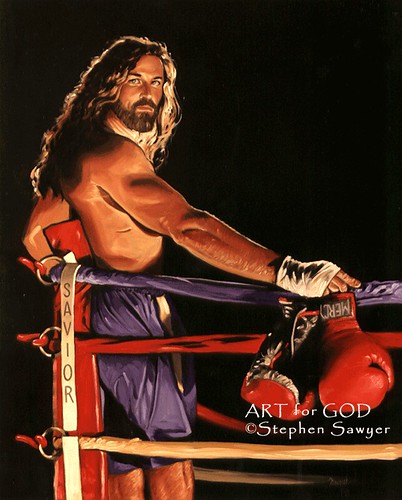
this is Jesus as the Trojan Horse. Jesus as the fish hook, humanity is the bait, and when the devil latches on, it's curtains for him. the fishhook is an ancient symbol for Christ. so is Christ the boxer or Christ the gladiator.

here evil is an external presences where in Dead Man Walking, evil was internal. and isn't that the case, that laws and systems can be corrupt and unjust and thus catch people up in the cogs? aren't there things in society that you rail against stating "this isn't the way it's supposed to be!" but are powerless to change?

well that's me playing the advocate for this theory. i still have more problems with this one than with the sacrificial model.

critics of Aulen raised objections stating that he is just a failed manacheist or Zoroastrian, which his dueling Good-God/Bad God. this would make him a polytheist! plus what kind of creator lets evil sneak into the world? that's rather incompetent. and doesn't God take God's sweet time in making the correction? why didn't God just nuke evil from the start? and if Christ conquers sin/death/devil then why do we still have crappiness/death/and evil?

Aulen wasn't dumb, not by any means. if good comes from some cosmic "font of goodness" then why can't the bad come from a similar font? what would it mean if it came from the same font? entropy exists much like the south did after Gettysburg. They couldn't win, yet they still fought. same with many isolated islands on the Japanese side in WWII. They knew they lost yet fought into the mid-50s anyway.

so Aulen states that Good Friday shouldn't be the focus (like in those sacrificial folk), Saturday shouldn't either because that's when Jesus is turning over hell, but Easter is the true V-day. Worship them should be a victory celebration and proclamation until the cosmos and humanity catch onto this fact.

i don't like the spiritual warfare motif. i think Aulen had to have written this before the 20s because after he saw the Nazi conspiring with the Lutheran church, i don't think he would have held that view. the church is just an agent of institutional evil as anything else out there and with the European Catholic scandal going on, i really don't feel the need to argue this point.

i don't like the idea of God tricking or deceiving nor the idea of God being indebted to evil or Satan or some how accidentally letting evil into the world. i really don't think there is a perfected shalomic state we were supposed to be in from the start, i think we're supposed to grow and constantly work toward that goal.

and then insert the objections i had in the last post to this one... although i find myself more at peace with the sacrificial model now than i have been in a long, long time. once penal substitution is ruled out, i'm cool with it. Christus Victor, however, is a super-hero story transposed onto the scriptures. God the good defeats the evil Satan, evil genius and ruler of this world. i don't remember reading anywhere in the scriptures about how the devil came into being. that is more Catholic oral tradition than anything else. i wonder where that stuff came from.

Where I'm At:  I'm more of a Trinitarian than i thought. I like the play of internal and external evil, but i'm not choosing one over the other. i think both are problems we gotta deal with both individually and corporately. i'm not a dualist (or duelist in this case) and see how good people do bad things and bad people do good things and how good can come out of bad and vice versa. so i see how both models can't cover everything, but what system or theory can?

Monday, March 08, 2010

Satisfaction Theory and Christus Victor

In this post i will reveal how big of a heretic i am, but before i do i would like to focus on a little picture i found at CollegeHumor.com as a preface.

The Satisfaction Theory along with Christus Victor are considered the prime view of the atonement. The Satisfaction Theory is called the "classic view" by Aulen and it was best articulated by Anselm of Canterbury in the 1100s. It is the one i have the most trouble with and I've always pushed against it. Even in Catholic school where I pretty much accepted everything the teacher said, when it came to this view of atonement and even the doctrine of original sin, i questioned pushed and just couldn't accept it. One or two times a letter went home with my mom, but I always got A's in religion. so i kinda feel like the kid who the teacher is writing about who is bucking authority. so this post seeks showcase the "classic view" briefly and put in my two cents on where i have trouble with it. the purpose of this post is to seek understanding of this view and have someone address the plot holes within this theory. i'm open, but skeptical.

Aulen states that the subject of the atonement is absolutely central in Christian theology and it is directly related to the nature of God (page 12). Indeed, i think this is correct because every religion sets up a problem for the world and then provides the solution. in the 'classic view' the problem is that humankind is sinful and sin affects the order of the universe. God needs satisfaction for this but humans can't provide it, because God and sin are supposedly infinite and humans are finite. So God in Christ reconciles the world by becoming human and satisfying the justice needed.

Christus Victor however, states that humanity is in bondage to sin/death/devil and the solution is for God/Jesus or God in Jesus to come down and destroy sin/death and free captive humanity from sin/death/devil. I do the slashes as this is the whole package facing mankind and has some important nuances within it. that being said, i'll lay out where Aulen gets this idea.

Irenaeus is the first dude to really tackle this problem. granted the images of atonement are indeed found within the gospels (specifically John) and the epistles (specifically Paul, Hebrews, and Peter) and the early hymns and liturgies of the church. why? well, it is my prof Lee Barrett's idea that theology is parasitic on religious life. the life, hymns and songs, happen first, the emotional/subjective experience; and then along comes theology to figure out what it all means. kinda like science (WARNING WARNING: science analogy about to be used! ;-)) where events occur naturally and the scientist comes along later to establish the how's and why's; the purpose of the subjective action.

Irenaeus was the first to articulate that the early church looked at Christ's death and resurrection and said "hey, i kinda feel forgiven. let's sing about it!" Irenaeus picks up on the Pauline and Johannine writings and sees there's some direct connection with the thought of Christ as victor over sin and death. The devil has some objective existence, lord of sin and death, and having deceived mankind in the garden has gained dominion over them. God being perfectly just, somehow honors this pact and seeks to free humanity from it. Since God finds mankind under the condemnation of the Law, God delivers mankind from the powers of evil and reconciled the world to Himself [sic] and God becomes both the reconciler and the reconciled.

Aulen traces the thoughts of Irenaeus through the patristic traditions and through Protestant thought as well. adding to this idea through fancy nuances like God attains his purpose by internal, not external means, he overcomes evil not by an almighty fiat but by putting something of his own through a divine self-oblation (Great Catechism ch. 26). all of these thoughts rest on the doctrine of the fall and a dualistic understanding of the world where "darkness cannot endure when the light shines nor can death remain in being where Life is active."

there is the start of my problems.

1. if the fall is not in the Jewish understanding of the story of Genesis, then how can this stand? if Genesis is just a story, then how can it have any genetic binding on the souls of people?

2. how did this concept of the devil come into being? where in scripture is the fall of Satan? where can i find this story in rabbinic thought? Islam has a cool story of Ibis and how in parts Ibis/Satan is a jinn or jealous of God's love for humanity or even working on behalf of God to tempt the faithful and test them (like in some strains of Judaism). is the devil co-equal with God? is this some Zoroastrian version of Christianity?

3. I don't agree with the dualistic idea that darkness can't be around light. aren't they not connected? isn't it the shadows that define light? aren't life and death two aspects of a spectrum and while we live we are yet actively dying, subjecting to the natural law of entropy?

so those are just the start of my questions. i have other concerns too, like the idea of how we were ransomed by God yet many weren't aware of the fact we were in bondage in the first place! shouldn't a memo have been sent to all the other religions?

Dear Pagans, Buddhists, Hindus, Shitos, Taoists, and Gentile-masses,
Hi, this is God. Not god or gods, but the great beyond that all of your avatars point to. I hate to be the bearer of bad news but y'all are in bondage. But don't worry! I'm coming down there and atoning for your sins and freeing you from Satan, who got a little too attached to his work. This will both be really cool, cause I'll give you things like the beattitudes and some parables, as well as get to fire Satan (which will be great cause now it'll give another angel a chance to win the office's March Maddness Bracket, Gabriel is really excited at this). Oh, one caveat, you have to believe both that you're in bondage and that this guy Yeshua of Nazareth is me (which he'll never come out and say directly, cause you know, I'm freaky mysterious like that).
Eternal Love,
-G.
In class we're going to discuss this and hopefully i can get some clarity and some help connecting the dots. Aulen didn't help here. in fact, he made it worse. too many assumptions going into this theory for it to hold up in light of science and what we know about the world today. it is too reliant on tradition and an outdated metaphysic of angels, demons, and heavenly hosty sorta stuff.

i can affirm the basic concept of a Divine Love which cannot be imprisoned in categories of merit and of justice and thus breaks them into pieces. THAT i get! that is what i feel these images and metaphors point to but fear that they are hopelessly outdated and bear really bad fruit. Just read the Proverbs of Ashes to see what the model of self-sacrificial love can do... esp. in terms of sexism! but that subject is a whole other post. i think that's enough ranting for now.